
If your business sends or receives money across borders, you already know how frustrating international banking can be. Payments arrive late, exchange rates eat into your margins, bank fees appear unexpectedly, and managing multiple currency accounts becomes a daily headache. That is why a Multi-Currency IBAN Account for International Payments has become one of the most searched financial solutions for global businesses in 2026.
As a fintech professional working with international merchants, I see the same challenge repeatedly: businesses are growing globally, but their banking infrastructure is still local. Whether you run an e-commerce brand, SaaS company, consulting firm, import-export business, fintech startup, or a high-risk online business, the ability to collect and manage payments in multiple currencies can directly affect your cash flow and profitability.
Today, businesses are actively searching for multi-currency IBAN account, business IBAN account, international payment account, virtual IBAN account, and cross-border payment solutions that offer faster settlements, lower FX costs, and easier access to global banking services.
For many companies, especially high-risk merchants, finding a reliable banking partner is no longer easy. Accounts are rejected, settlements are delayed, reserves are imposed, and international transfers are scrutinized. A well-structured multi-currency IBAN account for international payments can help reduce these operational bottlenecks and give businesses more control over their global transactions.
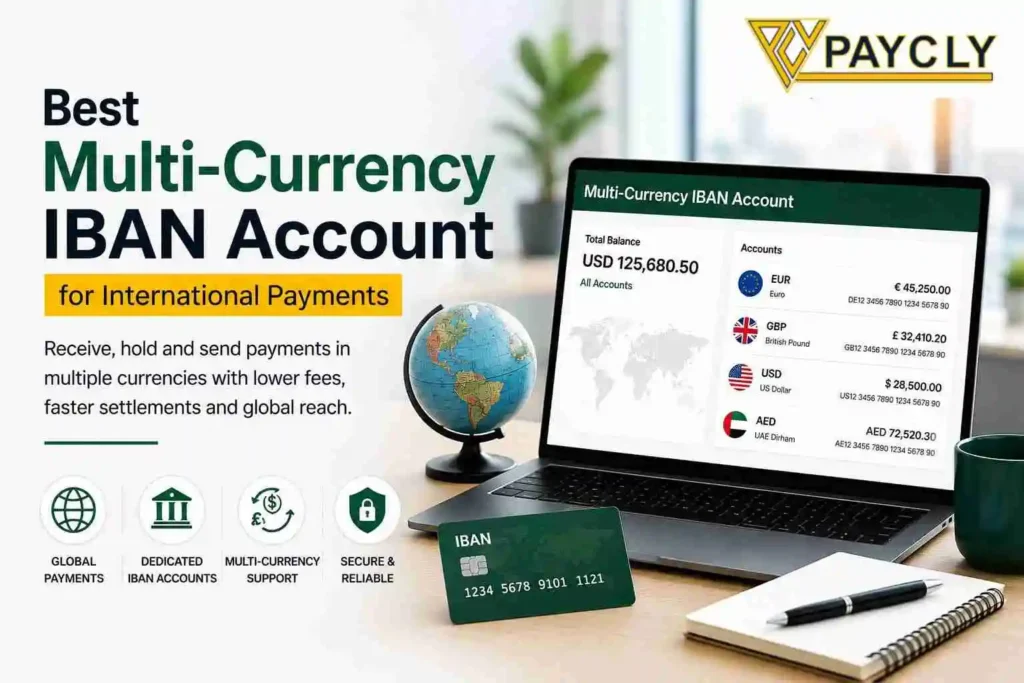
Why Businesses Are Moving to Multi-Currency IBAN Accounts
Think about how international business works today. A customer in Germany pays in euros, a supplier in the UK wants pounds, a software tool charges in dollars, and a partner in the UAE invoices in dirhams. If every payment is converted immediately through a traditional bank, the business loses money at almost every step.
A multi-currency IBAN account allows businesses to hold and manage several currencies from a single account setup.
What businesses usually gain
- Receive payments in EUR, GBP, USD, AED, SGD, and other major currencies.
- Avoid unnecessary currency conversions.
- Reduce international banking fees.
- Speed up settlements.
- Simplify accounting and reconciliation.
- Pay overseas suppliers directly from the same account.
- Manage global cash flow from one dashboard.
For growing businesses, this is less about convenience and more about protecting margins.
What Exactly Is a Multi-Currency IBAN Account?
An IBAN (International Bank Account Number) is a standardized account format used for international payments. A multi-currency IBAN account combines that international banking capability with the ability to hold multiple currencies under one business relationship.
Modern fintech providers often add features such as:
- Dedicated IBANs
- SEPA and SWIFT payment access
- Virtual IBANs for customer collections
- Online account management
- API connectivity
- Real-time transaction tracking
- Multi-user access controls
For businesses processing international payments daily, these features can save significant administrative time.
A Simple Real-World Example
Imagine a UK-based SaaS company selling subscriptions in Europe and the Middle East.
Without a multi-currency account:
- Euro payments are converted to pounds immediately.
- UAE payments are converted through intermediary banks.
- The business pays conversion fees twice—once when receiving funds and again when paying suppliers.
With a multi-currency IBAN account:
- Euro payments stay in EUR.
- UAE payments stay in AED.
- Funds are converted only when the business chooses.
- Suppliers can be paid directly in their local currency.
That single change often improves treasury control and reduces hidden FX costs.
The Reality for High-Risk Merchants
This is the part many articles avoid discussing honestly.
Businesses in sectors such as online gaming, Forex, adult services, IPTV, nutraceuticals, travel, digital goods, and other high-chargeback industries face a very different banking experience from mainstream businesses.
Bank applications get rejected
Many merchants spend weeks preparing documents only to receive a generic decline because the industry is labeled “high risk.”
Rolling reserves hurt cash flow
It is common for providers to hold a percentage of revenue for months, which can make payroll, advertising, and inventory payments difficult.
Settlements are delayed
A compliance review can suddenly pause payouts, leaving the business operating with limited working capital.
Accounts are closed unexpectedly
Some merchants receive little notice before losing access to their banking relationship.
International transfer costs are excessive
Intermediary banks add fees that are rarely disclosed upfront.
Onboarding takes too long
Waiting several weeks for account approval can delay business launches and international expansion.
Currency options are limited
Merchants may be forced to convert every payment into a single settlement currency, increasing costs.
I have spoken with business owners who were profitable on paper but struggled operationally because their funds were constantly tied up in reserves or delayed settlements. For a company processing significant monthly volume, a few days of payout disruption can create serious financial stress.
How a Specialized Multi-Currency IBAN Account Can Help
A fintech-oriented business IBAN account designed for international commerce can often provide a more practical solution than a traditional bank.
Benefits many high-risk merchants value
- Faster onboarding processes
- Better understanding of high-risk business models
- Multi-currency settlement options
- Dedicated compliance support
- Improved transaction visibility
- Easier reconciliation with payment gateways
- Reduced dependence on a single banking partner
It does not eliminate compliance obligations, but it can make day-to-day payment operations far more manageable.
Features Recommended Looking For Multi-Currency IBAN Account
When evaluating providers, I suggest focusing on practical business functionality rather than marketing claims.
Multi-currency support
Look for support for EUR, GBP, USD, AED, SGD, CHF, and other currencies relevant to your customers.
SEPA and SWIFT access
SEPA is essential for European collections, while SWIFT remains important for global transfers.
Dedicated IBANs
Dedicated IBANs make customer payment identification much easier.
Transparent FX pricing
Ask for the actual exchange spread, not just the transfer fee.
API integration
Critical for e-commerce platforms, SaaS businesses, marketplaces, and fintech companies.
High-risk industry support
Confirm that the provider works with your business sector.
Fast settlement times
Faster access to funds improves cash flow stability.
Strong online platform
Real-time reporting and payment tracking should be standard.
What Businesses Are Searching for Right Now
Search trends in 2026 show strong commercial intent around international payment infrastructure. Common searches include:
- best multi-currency IBAN account 2026
- business IBAN account for international payments
- IBAN account for non-residents
- online business IBAN account
- multi-currency account for e-commerce
- IBAN account for fintech companies
- cross-border payment account
- virtual IBAN for global business
- high-risk business IBAN account
These searches are driven by businesses actively looking for payment solutions, not just researching banking terminology.
Multi-Currency IBAN vs Traditional Corporate Bank Account
| Feature | Multi-Currency IBAN | Traditional Bank |
| Multiple currencies | Yes | Often limited |
| International onboarding | Usually easier | Often complex |
| SEPA support | Yes | Yes |
| SWIFT support | Yes | Yes |
| Virtual IBANs | Common | Rare |
| API integration | Common | Limited |
| High-risk business support | Better in many cases | Often restricted |
| FX transparency | Usually clearer | Often less transparent |
| Online management | Advanced | Varies |
For digital-first international businesses, the difference is often noticeable within the first few months of operation.
Example: International E-Commerce Merchant
Consider an Germany e-commerce company selling to Europe, the UK, and the UAE.
The business receives:
- EUR from European customers
- GBP from UK marketplaces
- USD from international suppliers
- AED from regional distributors
Without a multi-currency IBAN account, every incoming payment may be converted immediately, creating repeated FX costs. With a centralized international payment account, the merchant can collect locally, hold multiple currencies, and convert funds strategically when rates are favorable.
That can make a meaningful difference to operating margins over time.
Compliance Still Matters
A reputable provider will still require proper business verification. Expect requests for:
- Company registration documents
- Director and shareholder identification
- Proof of business activity
- Website review
- Expected transaction volumes
- Source of funds information
Businesses with organized compliance records generally experience smoother onboarding.
Questions We Encourage Clients to Ask
Before opening an account, ask these questions directly:
- Which currencies can I hold?
- Are the IBANs dedicated to my business?
- What are the FX conversion spreads?
- Are both SEPA and SWIFT supported?
- Do you work with my industry?
- What are the settlement timelines?
- Are reserves required?
- Can the account connect to my payment gateway?
- Can non-resident companies apply?
- What ongoing compliance reviews should I expect?
Clear answers usually reveal whether a provider is genuinely suitable for international business.
Why Payment Infrastructure Is Now a Growth Strategy
Many business owners still view banking as a back-office function. In reality, payment infrastructure influences customer experience, settlement speed, supplier relationships, international expansion, and overall cash-flow stability.
A weak banking setup quietly reduces profitability through fees, delays, and operational friction. A strong multi-currency payment solution can support faster growth and smoother global operations.
Why Businesses Work With PayCly
At PayCly, we work with international businesses and high-risk merchants that need practical global payment infrastructure, not generic banking products.
Our solutions are designed to support:
- Multi-currency IBAN accounts
- International payment collection
- Cross-border settlements
- Business payment management
- High-risk merchant payment solutions
- Global transaction support
- Dedicated onboarding assistance
Whether you are expanding into Europe, the UK, the Middle East, Southeast Asia, or multiple markets simultaneously, having the right payment infrastructure can remove many of the obstacles that slow international growth.
Final Thoughts
Choosing the best multi-currency IBAN account for international payments is no longer just a banking decision—it is a business decision. Companies operating globally need faster settlements, transparent FX pricing, reliable international banking access, and payment systems that scale with their growth.
For high-risk merchants, the need is even more urgent. Account rejections, frozen funds, rolling reserves, and delayed settlements can threaten day-to-day operations. A specialized multi-currency IBAN account, supported by a fintech provider experienced in international and high-risk payments, can provide the flexibility and stability that many traditional banks struggle to offer.
Global commerce is becoming increasingly digital and borderless. Businesses that build modern international payment infrastructure today will be in a much stronger position to expand internationally, protect cash flow, and deliver a smoother payment experience to customers around the world.
If you are looking for a multi-currency IBAN account for your international business or high-risk company, PayCly can help you explore a tailored cross-border payment solution designed for global growth. 👉Apply Now