
IBAN account vs business bank account is one of the most searched financial questions among international businesses in 2026. Whether you operate an eCommerce brand, SaaS company, fintech startup, gaming platform, forex brokerage, digital agency, or any business serving customers across borders, the account structure you choose directly affects payment acceptance, settlement speed, banking stability, compliance, and cash flow.
As companies expand into Europe, the United Kingdom, Singapore, the United Arab Emirates, Canada, and other global markets, they increasingly compare a business bank account with a multi-currency IBAN account. The right choice can reduce international payment friction, improve treasury management, and support long-term growth.
For high-risk merchants, this decision is even more critical. Many struggle with account rejections, delayed onboarding, rolling reserves, frozen settlements, and sudden account closures. This guide explains the differences between an IBAN account vs business bank account, highlights the pain points faced by high-risk businesses, and helps global companies choose the most suitable payment infrastructure.
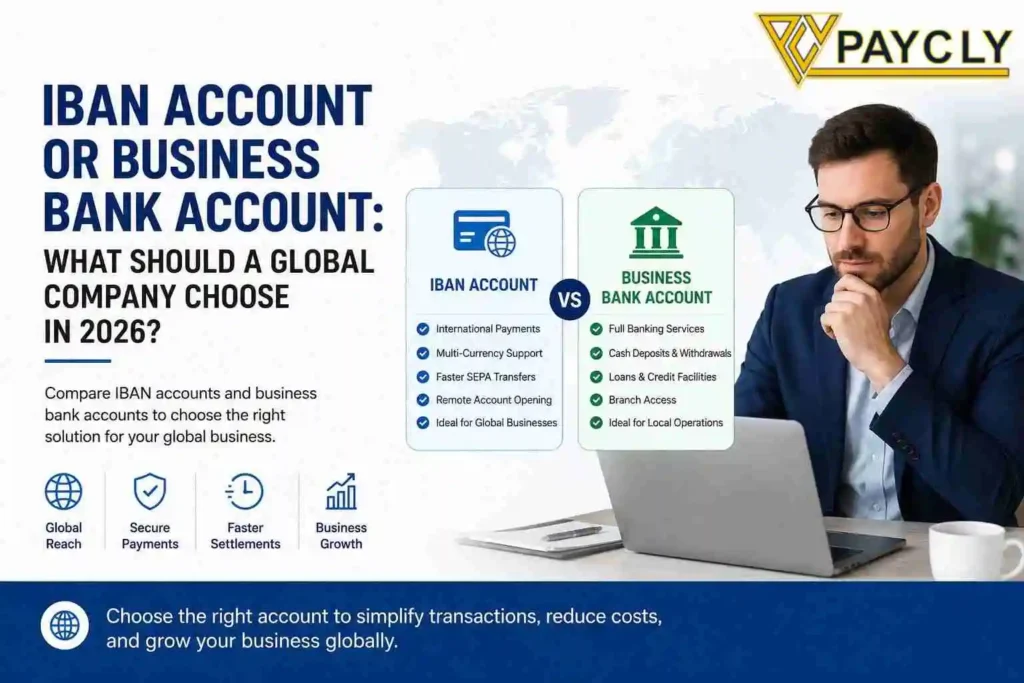
Why More Global Businesses Are Rethinking Their Banking Setup
International commerce has become digital-first. Businesses now:
- sell globally from day one,
- receive payments in multiple currencies,
- work with remote teams,
- pay international suppliers, and
- settle transactions across several countries.
Search interest continues to rise for terms such as business IBAN account, international business account, multi-currency IBAN account, SEPA business account, virtual IBAN account, and cross-border payment solution because companies want banking infrastructure designed for international operations rather than only domestic banking.
The real question is no longer “Can I open a bank account?” but “Which account structure will help my business scale globally with fewer banking restrictions?”
What Exactly Is an IBAN Account?
An IBAN account is an account identified by an International Bank Account Number (IBAN). The IBAN standard was created to make international payments more accurate and efficient, particularly within Europe and the SEPA region.
What makes an IBAN account useful for international businesses?
- Internationally recognized account format
- Faster SEPA transfers
- Easier cross-border collections
- Multi-currency support in many cases
- Online account management
- Simplified reconciliation for international payments
Many providers now offer online IBAN accounts and virtual IBAN accounts, allowing companies to open and manage accounts remotely without visiting a bank branch.
What Does a Traditional Business Bank Account Offer?
A business bank account is a traditional banking relationship with a licensed bank. It is primarily designed for domestic business operations and broader banking services.
What you typically get with a business bank account
- Local payments and collections
- Cash deposits and withdrawals
- Payroll processing
- Cheque services
- Business loans and overdrafts
- Trade finance and treasury services
- In-branch banking support
Traditional banks usually provide a wider range of financial products, but onboarding can be slower and more restrictive for international or high-risk businesses.
The Real Difference Between an IBAN Account and a Business Bank Account
| Feature | IBAN Account | Business Bank Account |
| International payments | Excellent | Good |
| SEPA transfers | Excellent | Excellent |
| Multi-currency support | Often included | Varies |
| Remote account opening | Common | Limited |
| Onboarding speed | Fast | Slower |
| Branch access | Usually no | Yes |
| Cash handling | Limited | Full |
| Credit facilities | Rare | Available |
| Best for global digital businesses | Excellent | Good |
| Best for local cash businesses | Limited | Excellent |
| High-risk business flexibility | Higher | Lower |
Where High-Risk Businesses Face the Biggest Banking Challenges
The comparison becomes most important for high-risk businesses.
Industries such as online gaming, forex, IPTV, subscription services, adult businesses, nutraceuticals, crypto-related services, travel, ticketing, and cross-border eCommerce are frequently categorized as high risk by traditional banks.
What high-risk business owners struggle with every day
- Account rejections: Many banks reject applications solely because of the industry classification.
- Lengthy compliance reviews: Approval can take weeks or even months, delaying product launches and revenue generation.
- Rolling reserves: Banks may hold 5%–20% of transaction revenue for 90–180 days, creating severe cash-flow pressure.
- Frozen settlements: Incoming funds may be delayed while compliance teams conduct additional reviews.
- Sudden account closures: Businesses can lose banking access with minimal notice, disrupting operations overnight.
- International payment restrictions: Transactions from certain countries may be delayed, rejected, or subject to enhanced scrutiny.
- Repeated documentation requests: Ongoing KYC and AML checks consume management time and operational resources.
For a growing online business, these issues are not minor inconveniences—they can affect payroll, supplier payments, advertising budgets, and customer refunds. A specialized high-risk IBAN account or international payment solution can often provide a more stable operational framework than a standard bank account.
When an IBAN Account Makes More Sense
An IBAN account for international business is usually the stronger option when a company operates across multiple countries.
An IBAN account is usually a better fit if…
- Your customers are international: If customers are spread across Europe and other regions, IBAN collections simplify payment receipt.
- You receive multiple currencies: A multi-currency IBAN account helps businesses receive EUR, GBP, USD, and other currencies without opening separate local accounts.
- You need fast onboarding: Fintech payment institutions often approve accounts faster than traditional banks.
- You run a digital-first business: SaaS companies, eCommerce brands, gaming businesses, fintech startups, consultants, and remote-service providers typically benefit from online account management.
- You operate in a high-risk industry: Specialized payment providers may better understand high-risk business models and cross-border transaction flows.
Example
A gaming company serving customers in Germany, France, Italy, and Spain can collect euro payments through a single IBAN structure instead of maintaining separate bank accounts in each country.
When a Traditional Business Bank Account Is the Better Option
A business bank account is generally preferable when the company has significant local operations.
A business bank account is usually a better fit if…
- You handle cash regularly.
- You operate physical retail locations.
- You run a manufacturing business.
- You need trade finance for import-export activity.
- You require loans or overdrafts.
- You have significant local payroll obligations.
- You need in-person banking support.
These companies usually need the broader banking relationship that a traditional bank provides.
The Hidden Costs Most Businesses Overlook
Many businesses compare only account-opening fees, but the real cost lies in payment operations.
| Cost Area | IBAN Account | Business Bank Account |
| International incoming transfer | Low | Medium–High |
| SEPA payment | Low | Low |
| Currency conversion | Competitive | Often higher |
| Monthly maintenance | Low–Medium | Medium–High |
| Cross-border collections | Low | Higher |
| Onboarding cost | Low | Higher |
For businesses processing large volumes of international transactions, lower FX spreads and reduced payment fees can produce meaningful annual savings.
What You Need to Prepare Before Applying
Whether you choose an IBAN account or a business bank account, strong compliance preparation is essential.
Typical requirements
- Certificate of incorporation
- Shareholder and director documents
- UBO identification
- Source of funds evidence
- Business model description
- Website review
- AML and sanctions screening
- Expected transaction profile
High-risk businesses should prepare a comprehensive compliance package before applying. Clear documentation significantly improves approval chances.
Why Many International Companies Use Both Accounts
In practice, many successful international businesses maintain both an IBAN account and a business bank account.
Use a business bank account for
- local taxes,
- payroll,
- domestic supplier payments,
- credit facilities, and
- treasury management.
Use an IBAN account for
- international customer collections,
- SEPA transfers,
- multi-currency settlements,
- overseas supplier payments, and
- cross-border revenue management.
This hybrid structure combines banking stability with payment flexibility.
What Global Businesses Are Actually Choosing in 2026
Current market trends show:
- eCommerce brands increasingly prefer multi-currency IBAN accounts.
- SaaS companies prefer online IBAN accounts for recurring international payments.
- Fintech startups often adopt virtual IBAN structures for scalable payment operations.
- Gaming and forex businesses increasingly work with specialized international payment providers.
- Traditional exporters and manufacturers continue to rely heavily on business bank accounts.
The choice is increasingly driven by where payments originate and settle, not by company size.
A Simple Way to Decide What Your Business Needs
Before choosing between an IBAN account and a business bank account, ask these five questions.
1. Are more than 50% of your customers international?
If yes, an IBAN account is usually the better choice.
2. Do you need loans, overdrafts, or trade finance?
If yes, keep a business bank account.
3. Do you operate in a high-risk industry?
If yes, evaluate specialized high-risk IBAN and payment solutions.
4. Do you need to receive payments in EUR, GBP, USD, and other currencies?
If yes, choose a multi-currency IBAN account.
5. Do you handle cash or require branch services?
If yes, maintain a traditional business bank account.
What the answers usually mean
If your business answers “yes” to questions 1, 3, and 4, an IBAN-based international payment solution is often the stronger primary option for global operations.
Why Your Payment Setup Matters More Than Ever
For international businesses, banking is no longer just about holding money. It is about:
- payment acceptance,
- settlement reliability,
- currency management,
- compliance resilience,
- customer experience, and
- operational continuity.
High-risk merchants that rely on a single restrictive bank relationship are especially vulnerable. Diversifying payment infrastructure through specialized international payment solutions can reduce operational risk and improve business continuity.
How Paycly Helps International Businesses
At Paycly, we work with international businesses that need reliable cross-border payment infrastructure, including companies that face challenges with traditional banks. The objective is not merely to open an account; it is to build a payment ecosystem that supports global collections, settlements, compliance, and scalable growth.
For high-risk merchants, the right account structure can be the difference between sustainable international expansion and constant banking disruption.
Final Thoughts: Which Account Should You Choose?
There is no single winner for every business.
- Choose an IBAN account if your company is digital, international, multi-currency, and growth-focused.
- Choose a business bank account if your company is local, cash-intensive, credit-dependent, or operationally tied to one country.
- Choose both if you want a stronger global treasury and payment structure.
For most modern international businesses—especially eCommerce, SaaS, fintech, gaming, forex, and other cross-border companies—a combination of a multi-currency IBAN account and a strategic business banking relationship provides the best balance of flexibility, compliance, payment efficiency, and scalability.
If your business is struggling with account rejections, delayed settlements, reserve requirements, frozen funds, or international payment limitations, now is the right time to reassess your banking structure and move toward a solution designed specifically for global commerce.
Paycly helps international and high-risk businesses access reliable payment solutions designed for cross-border transactions, multi-currency operations, and global business growth.
Contact Paycly today to discuss your business requirements and find the right international payment solution for your company.