
A Multi-Currency IBAN Account for International Payments can give international businesses a more practical way to receive, hold, convert, and send money across different markets. For companies dealing with customers, suppliers, marketplaces, payment platforms, or partners in multiple countries, managing every transaction through a traditional single-currency bank account can quickly become expensive and complicated.
The challenge becomes even greater for high-risk merchants.
Businesses operating in sectors such as forex, online gaming, gambling, travel, subscriptions, digital services, and other higher-risk categories can face stricter onboarding, enhanced compliance reviews, account limitations, delayed settlements, and fewer banking options. A business may be profitable and fully operational but still struggle to find financial infrastructure that understands its transaction model.
That is why businesses are increasingly researching solutions such as a multi-currency IBAN account, business IBAN account, virtual IBAN account, international payment account, and cross-border payment solution.
An IBAN itself is a standardized identifier for a bank account. SWIFT explains that the IBAN standard is designed to facilitate automated processing of cross-border payments and follows ISO 13616 specifications.
For businesses operating internationally, the real value comes from combining this standardized account infrastructure with practical multi-currency capabilities.
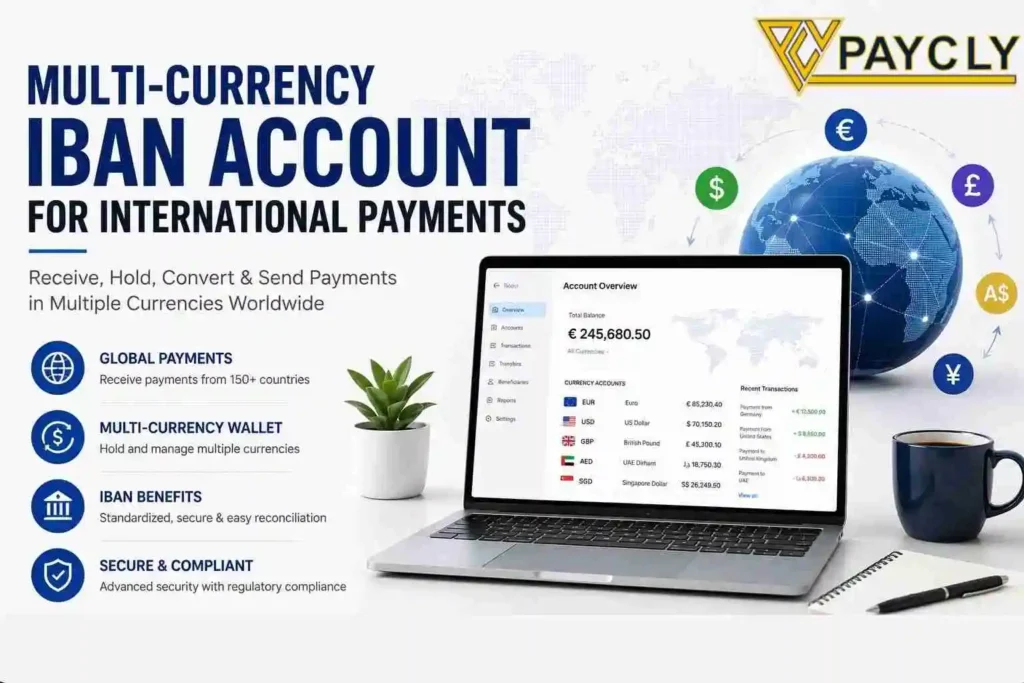
What Is a Multi-Currency IBAN Account?
A multi-currency IBAN account is a business payment solution that allows eligible companies to manage transactions in more than one currency within a structured account environment.
Instead of constantly converting incoming funds into one base currency, a business may be able to maintain balances in supported currencies and use those balances for eligible payments or conversions.
For example, an international business might receive:
- EUR from customers in Germany
- GBP from customers or partners in the UK
- USD from U.S. customers
- AED from partners in the UAE
- SGD from customers or suppliers in Singapore
The exact currencies and capabilities depend on the provider and underlying financial institutions.
This matters because currency conversion is not merely an accounting issue. Frequent conversions can introduce FX costs, timing differences, reconciliation work, and cash-flow uncertainty.
For businesses with international revenue, the ability to manage multiple currencies can therefore become part of the overall payment strategy.
Why International Businesses Need Multi-Currency Payment Infrastructure
Global commerce rarely happens in one currency anymore.
A SaaS company might bill customers in USD while paying software suppliers in EUR. An eCommerce business may receive GBP and EUR while paying manufacturers in USD. A consulting firm may invoice clients in several markets while maintaining contractors across different countries.
If every incoming payment is immediately converted into the company’s home currency, the business may lose flexibility.
A multi-currency business account can potentially help businesses:
- Receive eligible payments in supported currencies
- Hold balances in multiple currencies
- Pay international suppliers
- Manage cross-border transfers
- Reduce unnecessary conversion cycles
- Improve reconciliation
- Separate revenue by currency
- Manage international cash flow more efficiently
For euro payments specifically, SEPA provides a common set of standards designed to make cross-border euro payments easier to process across participating countries. The European Commission describes SEPA as a framework that makes cross-border euro payments as easy as domestic payments.
That makes the combination of IBAN + multi-currency support + appropriate payment rails increasingly relevant for internationally active businesses.
How a Multi-Currency IBAN Account Supports Cross-Border Payments
An international IBAN account can simplify the account information businesses provide when receiving eligible bank transfers.
The basic process is straightforward:
Customer or business partner → IBAN/account details → payment network → business account → reconciliation
The IBAN helps identify the destination account using a standardized structure. SWIFT notes that IBAN is an international standard for identifying bank accounts and facilitating cross-border payment processing.
For businesses, the operational benefits can include easier payment instructions, fewer manual account-entry issues, and more streamlined reconciliation.
But businesses should understand an important distinction:
An IBAN is not automatically a bank license, merchant account, payment gateway, or universal international payment solution.
The actual capabilities depend on the financial institution or regulated provider behind the account.
Before opening an account, businesses should check:
- Which currencies are supported
- Where the account can receive payments from
- Which payment rails are available
- Whether SEPA payments are supported
- Whether SWIFT transfers are available
- Where funds are legally held
- Which entity provides the account
- Settlement and transfer limits
- Applicable compliance requirements
- FX conversion costs
- Whether the business industry is accepted
These questions become particularly important for high-risk businesses.
Why High-Risk Merchants Struggle With International Banking
A high-risk business can have a strong website, legitimate customers, solid revenue, and appropriate documentation and still encounter banking difficulties.
The problem is often the perceived risk profile of the industry.
1: Account applications can be rejected
Some traditional banks and financial institutions have strict risk policies around industries such as forex, gambling, gaming, adult businesses, supplements, travel, and other sectors.
A merchant can spend weeks preparing incorporation documents, ownership information, invoices, financial statements, licenses, and transaction projections only to receive a generic rejection.
For a growing company, that means lost time and delayed expansion.
2: Compliance reviews can interrupt operations
High-risk merchants often experience more detailed KYC/KYB and transaction monitoring.
A sudden increase in transaction volume, payments from a new country, or unusual transaction patterns can trigger additional review.
The issue is not necessarily that the transaction is illegitimate. The problem is that the business may need to provide additional documentation before funds can move normally.
3: Delayed settlements create cash-flow pressure
This is one of the biggest pain points for high-risk businesses.
Imagine an online business that has to pay advertising costs, employees, suppliers, affiliates, and technology providers every week.
If a significant portion of incoming revenue becomes temporarily unavailable, the business can face a working-capital problem even when sales are strong.
That is why faster and more predictable international settlements can be commercially important.
4: Currency restrictions increase costs
A merchant receiving EUR but operating expenses in USD may need to convert funds before making payments.
If the business processes thousands of international transactions, repeated conversion can become a meaningful operating expense.
A multi-currency structure can give eligible businesses more flexibility over when and how supported currencies are converted.
Multi-Currency IBAN Account vs. Traditional Business Bank Account
The two should not automatically be viewed as competing products.
A traditional business bank account may remain essential for payroll, local expenses, lending relationships, tax payments, and other banking requirements.
A multi-currency IBAN account, meanwhile, can complement the company’s banking structure by providing additional infrastructure for international collections and payments.
| Feature | Traditional Business Account | Multi-Currency IBAN Solution |
| Single-currency management | Common | Often supports multiple currencies |
| International collections | Depends on bank | Designed for international use |
| Currency management | May require separate accounts | Multiple supported currencies may be available |
| Cross-border transfers | Available depending on bank | Core use case for many providers |
| Online account management | Usually available | Usually digital-first |
| API capabilities | Bank-dependent | Often available with fintech-oriented solutions |
| High-risk industry support | Varies | Provider-specific |
| Virtual account capabilities | Limited/varies | May be available |
The right solution depends on the company’s activities, countries, transaction volumes, and compliance profile.
Key Features to Look for in a Multi-Currency IBAN Account
Not every account marketed as “multi-currency” will offer the same functionality.
If your objective is international payment processing, look beyond the number of currencies advertised.
1. Multi-Currency Holding
The most obvious requirement is the ability to hold supported currencies instead of automatically converting every incoming payment.
Check whether the currencies you actually need are supported.
2. International Payment Collection
Businesses should understand exactly how they can receive payments.
Can customers or business partners send bank transfers directly? Are local account details available? Are SEPA or SWIFT transfers supported?
These details can materially affect your payment experience.
3. Transparent FX Pricing
A provider may advertise a low account fee while making its revenue through currency conversion spreads or transfer fees.
Ask for a complete fee schedule covering:
- Incoming payments
- Outgoing transfers
- Currency conversion
- Account maintenance
- International transfers
- Failed payments
- Refunds where applicable
4. Transaction Monitoring
International payment accounts operate within financial compliance frameworks.
A serious provider should have appropriate KYC/KYB, transaction monitoring, and compliance processes.
For high-risk businesses, transparent compliance requirements are preferable to vague promises of “no questions asked” banking.
5. Integration and Reporting
A growing company may need to connect its payment account with accounting software, payment gateways, ERP systems, or internal finance tools.
PayCly’s international payment infrastructure, for example, promotes real-time reporting and transaction/settlement visibility as part of its broader payment platform.
For businesses processing substantial international volume, better reporting can make reconciliation considerably easier.
Why Multi-Currency IBAN Accounts Matter for High-Risk Businesses
The benefits can be especially relevant when a high-risk merchant operates internationally.
Consider a forex company serving customers across Europe, the UK, and other permitted markets.
It may receive payments in EUR and GBP while paying technology providers, affiliates, employees, and other suppliers in different currencies.
Or consider an international eCommerce company that receives customer payments in several currencies but pays suppliers in USD.
Without an effective multi-currency payment solution, the business may end up maintaining several accounts, repeatedly converting currencies, manually reconciling payments, and dealing with multiple financial institutions.
For a high-risk merchant, every additional banking relationship can also mean another compliance process.
A properly structured high-risk IBAN account can potentially consolidate part of that operational workload, subject to the provider’s eligibility criteria and regulatory framework.
It does not remove compliance obligations. Instead, the objective is to create payment infrastructure that is better aligned with the company’s actual business model.
Multi-Currency IBAN Accounts for Different Business Models
The demand for international payment infrastructure is not limited to one industry.
1: eCommerce: International online retailers can receive payments in supported currencies and use their balances for eligible supplier or operating payments.
2: SaaS and Digital Services: Software companies selling subscriptions globally can benefit from structured international collections and easier reconciliation.
3: Forex Businesses: Forex businesses often operate across multiple jurisdictions and currencies, making multi-currency business banking particularly relevant.
PayCly already provides forex-focused merchant account and payment solutions, including multi-currency processing and international payment capabilities.
4: Gaming and Online Entertainment: International gaming businesses may have customers, affiliates, technology providers, and operational expenses spread across several markets. Their financial infrastructure therefore needs to accommodate cross-border activity while meeting applicable compliance requirements.
5: Travel Businesses: Travel companies routinely deal with multiple currencies, international customers, airlines, hotels, suppliers, and booking partners.
A multi-currency structure can help simplify the movement and reconciliation of funds.
How PayCly Supports International Payment Requirements
For businesses evaluating a multi-currency IBAN account for international payments, PayCly positions its broader platform around global, multi-currency payment infrastructure.
Its published information describes global account infrastructure, virtual account capabilities, and the ability to collect, convert, pay, and manage multiple currencies.
PayCly also promotes international payment infrastructure covering 150+ countries and multi-currency processing through its payment platform.
For high-risk businesses, PayCly’s merchant-account materials specifically highlight industry support, multi-currency acceptance, multiple payment methods, international support, transaction reporting, and security controls.
The important point for businesses is to discuss their actual industry, countries served, expected transaction volume, currencies, source of funds, ownership structure, and payment requirements before selecting an account.
Eligibility, supported currencies, payment rails, limits, and compliance requirements can vary by product and business.
What Documents May Be Required?
Businesses should expect a legitimate provider to conduct appropriate due diligence.
Depending on the provider and business model, documentation may include:
- Certificate of incorporation
- Business registration documents
- Ownership information
- Director and beneficial-owner identification
- Proof of business address
- Website and product information
- Invoices or contracts
- Bank statements
- Processing history
- Expected transaction volumes
- Source-of-funds information
- Relevant licenses or regulatory documentation
High-risk businesses may need to provide additional information.
This is not necessarily a disadvantage. A thorough onboarding process can indicate that the provider is actually assessing the business rather than making unrealistic promises.
How to Choose the Right Multi-Currency IBAN Provider
Before opening an account, ask five commercial questions.
Q: Does the provider support my industry?
A multi-currency account is of little value if your business category is excluded.
Q: Can it support my target markets?
Check whether customers and suppliers in your key countries can send and receive eligible payments.
Q: What currencies can I hold?
Focus on the currencies your business actually uses rather than an impressive headline number.
Q: What will international payments really cost?
Calculate transfer fees, FX spreads, intermediary charges, and account fees together.
Q: How will compliance reviews affect my cash flow?
Understand what documentation may be requested and what happens if a transaction requires additional review.
Final Thoughts
A Multi-Currency IBAN Account for International Payments can be a valuable part of a modern international business’s financial infrastructure.
For companies operating across Europe, the UK, the UAE, Singapore, North America, and other international markets, managing several currencies through a structured payment solution can simplify collections, supplier payments, reconciliation, and cash-flow management.
IBAN provides a standardized framework for identifying bank accounts and facilitating cross-border payment processing, while SEPA provides common standards for euro payments across its participating area.
For high-risk merchants, the decision requires more care. Account approval, compliance reviews, settlement timing, transaction limits, currency support, and industry acceptance can have a direct impact on daily operations.
The right solution is therefore not simply the account with the largest currency list.
It is the payment infrastructure that fits your business model, transaction profile, international markets, compliance requirements, and growth plans.
If your business is expanding internationally and struggling with multiple currencies, delayed settlements, expensive conversions, or limited banking options, it may be time to evaluate a more specialized payment structure.
Explore PayCly’s international and multi-currency payment solutions and discuss your business requirements with a payment specialist.