
For international businesses, opening a European account can become surprisingly difficult once the company operates across borders, has non-resident owners, or works in an industry that payment providers classify as higher risk.
A company may be incorporated in the UK, the UAE, Singapore, the US, or another jurisdiction while serving customers throughout Europe. Yet when that business needs to receive EUR payments, pay European suppliers, manage subscriptions, or simplify international settlements, the lack of suitable European payment infrastructure can become a genuine operational problem.
That is where a Business IBAN Account can become commercially useful.
An IBAN provides a standardized way of identifying a payment account. Within SEPA, IBANs are used for euro credit transfers and direct debits, and the European Payments Council explains that the IBAN is sufficient for processing SEPA payments under the “IBAN only” rule.
However, businesses should not assume that every provider offering an IBAN provides the same underlying service. A traditional bank account, payment account, electronic-money account, and virtual IBAN arrangement can have different features, regulatory structures, settlement capabilities, and onboarding requirements.
For non-resident business owners, choosing the right structure is therefore more important than simply finding an account that displays a European IBAN.
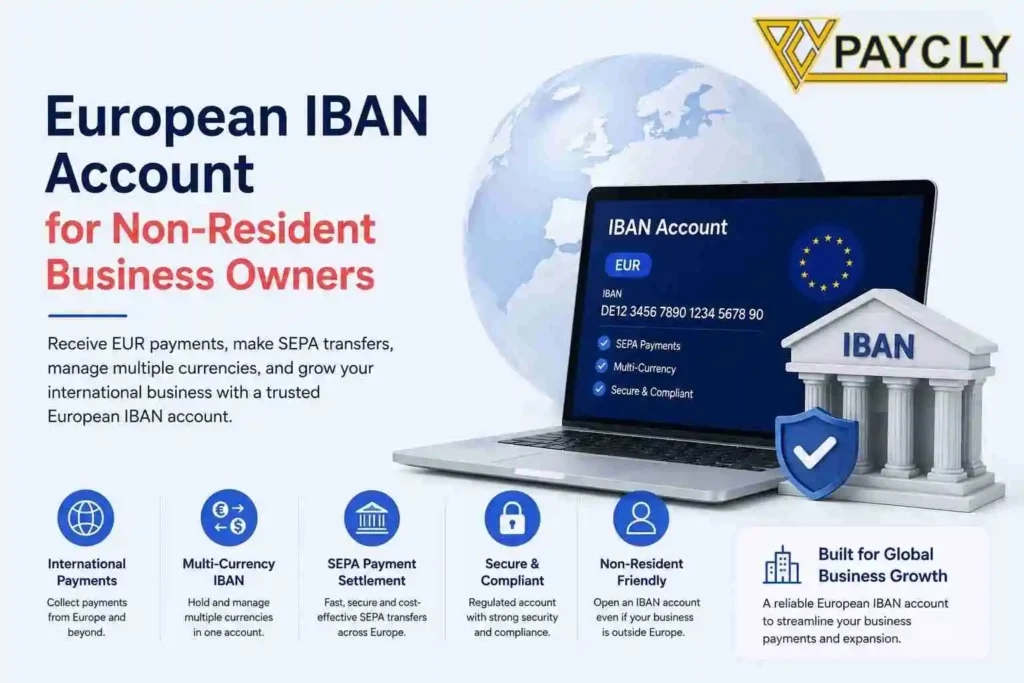
Why Non-Resident Businesses Need a European IBAN Account
Running an international company without suitable European payment infrastructure can create unnecessary friction.
A business selling software to customers in Germany, operating an e-commerce company serving France, or providing professional services to clients across the EU may need to receive EUR payments efficiently and maintain predictable settlement.
Without appropriate infrastructure, businesses can encounter:
- Higher international transfer costs
- Longer settlement times
- Difficulties paying European suppliers
- Complicated currency conversion
- Additional reconciliation work
- Limited access to local payment methods
- More complicated treasury management
A properly structured IBAN Account for Non-Residents can help eligible businesses centralize euro-denominated transactions while maintaining their wider international banking and payment relationships.
But eligibility is not automatic.
Providers generally assess the company, its owners, business activity, expected transaction flows, jurisdictions, source of funds, and compliance profile before approving an account.
That is particularly important for companies operating in sectors that face additional scrutiny.
Business IBAN Account for International Companies
A Business IBAN Account is designed to facilitate business payments rather than personal banking.
For an international company, its value often comes down to practical functionality: receiving payments, making transfers, managing supplier payments, reconciling transactions, and handling multiple currencies.
The European Payments Council notes that IBAN and BIC are standardized identifiers used within European payment schemes, helping identify payment accounts and payment service providers.
For a non-resident company, however, the key question isn’t simply:
“Can I get a European IBAN?”
The better question is:
“What can I actually do with that IBAN?”
Businesses should check whether the provider supports incoming and outgoing SEPA payments, EUR settlement, multiple currencies, business transfers, payment references, API connectivity, transaction reporting, and the company’s intended jurisdictions.
That distinction can prevent problems later.
Corporate IBAN Account vs Traditional Bank Account
A Corporate IBAN Account can provide payment functionality for an incorporated business, but the account structure depends on the provider.
Some services are offered by banks, while others may be provided through regulated payment institutions or electronic-money institutions. The regulatory framework matters because it determines what services are being provided and how the customer’s funds are handled.
The European Commission’s payment-services framework covers regulated payment services and related requirements across the EU.
Therefore, merchants should investigate:
- Who actually provides the account
- Which regulated entity holds or safeguards funds
- Where the account is serviced
- Whether the account supports SEPA transfers
- Whether local collection is available
- Which currencies are supported
- What happens if transaction volumes increase
- What compliance reviews may apply
This is especially important when comparing fintech platforms with conventional banks.
An IBAN alone doesn’t tell you the complete story.
Virtual IBAN Account: What Businesses Should Understand
A Virtual IBAN Account can be useful for companies that need dedicated payment identifiers for receiving funds without opening a conventional banking relationship in every country where customers are located.
Virtual IBAN structures can be particularly useful for businesses with international payment flows because they can simplify reconciliation and help identify incoming payments.
But “virtual IBAN” is not synonymous with “bank account.”
The exact functionality depends on the provider and underlying account structure. Some virtual IBAN solutions may support receiving payments only, while others can provide broader payment-account functionality.
For that reason, international businesses should examine the provider’s terms carefully before relying on a virtual account as their primary treasury solution.
Multi-Currency IBAN Account for Global Businesses
Currency management becomes more important as a business expands internationally.
A company receiving EUR from European customers but paying suppliers in GBP, USD, or another currency can lose money through unnecessary conversions and inefficient settlement arrangements.
A Multi-currency IBAN Account may allow eligible businesses to manage several currency balances through one payment relationship.
For an international e-commerce business, for example, this can make it easier to separate EUR revenue from other operating currencies and decide when currency conversion should take place.
The commercial benefit isn’t simply convenience.
Better currency management can improve:
- Cash-flow visibility
- Reconciliation
- Supplier payments
- Currency conversion planning
- International settlement management
- Treasury efficiency
Businesses should still compare the provider’s exchange rates, conversion fees, supported currencies, transfer limits, and settlement terms rather than assuming that “multi-currency” automatically means lower costs.
IBAN Payment Settlement and Cash-Flow Management
IBAN payment settlement is particularly important for businesses that process significant international transaction volumes.
Imagine a European-facing subscription company receiving thousands of EUR payments each month. If those payments are routed through complicated international arrangements, finance teams may spend unnecessary time matching payments, identifying customers, reconciling invoices, and moving funds between accounts.
A suitable European payment structure can simplify parts of that process.
SEPA’s standardized payment framework is designed around common rules and technical standards, while the European Payments Council identifies IBAN as one of the key account identifiers used in SEPA payment schemes.
For merchants, the practical objective is straightforward:
Receive funds efficiently, identify transactions accurately, and move business money where it needs to go.
That becomes even more important when payment volumes grow.
IBAN Account for International Business: What Non-Residents Should Prepare
Non-resident business owners should expect more detailed onboarding than simply providing a company registration document.
Financial institutions and payment providers have regulatory obligations to understand their customers and assess financial-crime risks.
The European Banking Authority’s guidelines emphasize customer due diligence, beneficial-owner identification, understanding the nature of the business relationship, and risk-based assessment of individual business relationships.
Depending on the provider and business, onboarding may involve:
- Certificate of incorporation
- Company registration details
- Ownership structure
- Beneficial-owner information
- Director identification
- Proof of business address
- Website and business-model information
- Expected transaction volumes
- Expected payment corridors
- Source-of-funds information
- Licenses or regulatory documentation where applicable
- Existing financial statements or processing history
This is one area where businesses sometimes create avoidable problems.
Providing incomplete information can lead to additional questions, delayed onboarding, or rejection.
A better approach is to prepare a complete business profile before applying.
High-Risk IBAN Account Challenges for Merchants
The challenge becomes greater for businesses operating in sectors that may receive enhanced scrutiny.
A High-risk IBAN Account should not be treated as a special account that bypasses compliance requirements. Rather, businesses in higher-risk sectors may need a provider capable of evaluating their business model through an appropriate risk-based process.
The EBA’s guidance makes clear that financial institutions assess money-laundering and terrorist-financing risk factors and adjust customer due diligence measures according to the risks identified.
For high-risk merchants, this can translate into a more demanding onboarding process.
A forex business, gaming company, nutraceutical merchant, subscription platform, or other specialized online business may be asked to provide more information about its customers, markets, licenses, transaction patterns, and source of funds.
This can be frustrating when the company is legitimate.
For example, a regulated forex business serving customers across the UK and EU may have strong financial controls but still face additional questions because of its industry and cross-border transaction profile.
Likewise, an international subscription business can experience scrutiny because recurring billing and customer disputes may create additional payment risk.
The solution isn’t to hide the business model.
It is to work with a provider that understands the actual risk profile and can assess the company appropriately.
IBAN Account for Fintech Companies
Fintech companies often have more complex payment requirements than conventional businesses.
A company may need to collect funds, make payouts, manage multiple currencies, integrate payment APIs, reconcile transactions automatically, and connect its payment infrastructure with accounting or operational systems.
An IBAN Account for Fintech Companies can therefore be valuable when the underlying provider supports the technical and payment capabilities required by the business.
Before selecting a provider, fintech companies should evaluate:
- API availability
- Webhook support
- Transaction reporting
- Multi-currency functionality
- SEPA payment support
- Automated reconciliation
- Account limits
- Settlement timelines
- Compliance requirements
- Integration options
The account should fit the company’s technology stack—not force the business to redesign its payment operations around the provider.
Online IBAN Account Opening: What to Look For
The ability to complete Online IBAN Account opening can make onboarding more convenient, particularly for international founders who cannot visit a European branch.
However, online onboarding doesn’t mean “no compliance.”
A regulated provider still needs to verify the business and its ownership structure.
The EBA emphasizes that customer due diligence includes identifying customers and verifying identity using reliable and independent information.
Therefore, businesses should be cautious about providers promising guaranteed approval, anonymous accounts, or accounts that bypass normal compliance checks.
For legitimate businesses, a transparent onboarding process is usually a better long-term proposition.
Can Non-Residents Use European IBAN Services?
In many cases, non-resident businesses can access European payment services, but availability depends on the provider, the company’s jurisdiction, ownership structure, business activity, and compliance assessment.
There is no universal rule that guarantees every non-European owner or foreign company will receive a European IBAN.
Businesses should also understand that having an IBAN from one European country does not automatically mean the company has a local bank branch, tax residency, or physical establishment there.
Another important issue is IBAN discrimination. The European Commission states that customers should not be prevented from making or receiving SEPA credit transfers or using SEPA direct debit simply because their account is located in another EU Member State.
For businesses operating across Europe, this can be an important practical consideration when accepting or making SEPA payments.
Choosing the Right European IBAN Provider
The cheapest account isn’t necessarily the best account for an international business.
A better comparison should cover the complete payment environment.
Look at:
1. Regulatory status: Understand which regulated entity provides the service.
2. Supported countries: Confirm that the provider accepts your company and ownership jurisdictions.
3. Currencies: Check whether EUR and your other operating currencies are supported.
4. Payment capabilities: Review SEPA transfers, international payments, collections, and payouts.
5. Settlement: Understand processing times, limits, fees, and settlement conditions.
6. Compliance requirements: Ask what documentation and ongoing reviews may apply.
7. Technology: For fintech and online businesses, API and reporting capabilities can be critical.
8. Scalability: Make sure the provider can accommodate legitimate increases in transaction volume.
Why the Right European IBAN Matters for Growth
For international businesses, payment infrastructure is no longer simply an administrative function.
It affects cash flow, supplier relationships, reconciliation, customer payments, international expansion, and operational efficiency.
A suitable IBAN Account for International Business can help eligible companies manage European payment flows more efficiently, but the right solution depends heavily on the company’s structure and requirements.
This is particularly relevant for high-risk businesses.
A company may already be dealing with stricter merchant-account underwriting, payment gateway limitations, chargeback exposure, and cross-border compliance requirements. Adding an unsuitable account provider can create another operational bottleneck.
The objective should therefore be to build a payment setup that works together: merchant acquiring, payment gateway, settlement account, currency management, compliance, and reporting.
Looking for European Payment Infrastructure for Your Business?
If you’re a non-resident business owner looking for a Business IBAN Account, Multi-currency IBAN Account, or payment infrastructure for an international or higher-risk business, start by assessing your transaction profile, countries, currencies, business model, and compliance requirements.
PayCly can help businesses evaluate payment and acquiring requirements based on their individual operating model and target markets.
The right European payment solution isn’t simply about obtaining an IBAN. It’s about creating a reliable settlement and payment structure that can support your business as transaction volumes, markets, and operational requirements grow.