
Finding the best payment gateway for online casinos is rarely about choosing the provider with the lowest advertised processing fee. For regulated casino and iGaming businesses, payment infrastructure needs to handle much more: transaction security, customer authentication, chargeback management, multiple payment methods, geographic restrictions, compliance, and reliable settlement.
Online casino operators serving customers across the UK, Europe, North America, and other regulated markets can face particularly demanding payment requirements. A gateway that works for a conventional ecommerce store may not be suitable for a gaming business with higher transaction risk and strict regulatory obligations.
For casino operators, the right payment infrastructure should therefore be evaluated as part of the overall compliance and financial strategy—not simply as a checkout tool.
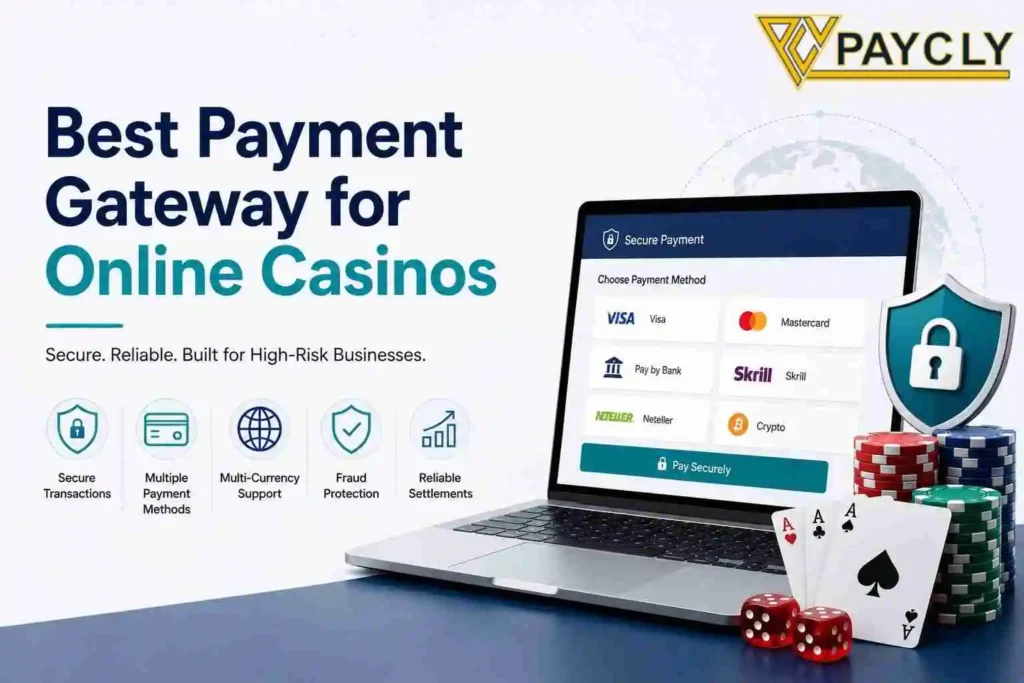
What Makes a Payment Gateway Suitable for Online Casinos?
A casino payment gateway connects the operator’s website or gaming platform with payment processors and acquiring institutions. Its job is to securely facilitate eligible transactions while helping the merchant manage payment data and transaction flows.
However, online casino payments have additional requirements compared with ordinary ecommerce.
Operators may need to support:
- Credit and debit card payments
- Bank-based payment methods
- Digital wallets where permitted
- Multiple currencies
- Deposits and withdrawals
- Recurring or repeat transactions where applicable
- 3D Secure authentication
- Fraud monitoring
- Chargeback management
- Transaction reporting
- Regulatory and compliance controls
The exact payment methods available depend on the operator’s jurisdiction, licensing position, customer locations, acquiring arrangements, and provider policies.
That is why there is no universal “best” casino gateway. The strongest option is the one that fits the operator’s business model, licensed markets, risk profile, and payment requirements.
Why Online Casinos Are Considered High Risk
Online gaming is commonly treated as a high-risk merchant category because of factors such as transaction volumes, chargeback exposure, regulatory requirements, fraud risk, and the potential for rapid movement of funds.
This can make obtaining a suitable casino merchant account more complicated than opening a standard ecommerce merchant account.
A casino operator might have a fully legitimate business but still encounter additional underwriting requirements. Acquirers and payment providers may request information about the operator’s license, ownership structure, customer geography, expected transaction volumes, website, terms and conditions, responsible-gaming policies, and compliance procedures.
For operators, this can be frustrating.
A business may have invested heavily in technology, licensing, marketing, and customer acquisition, only to discover that its payment infrastructure cannot support its expected transaction activity.
The problem becomes particularly serious when a merchant relies on a single payment route.
If that relationship is reviewed, restricted, or interrupted, deposits can be affected and customer experience can deteriorate quickly.
Casino Payment Processing Requires Strong Risk Controls
A reliable online casino payment processing setup needs to balance transaction acceptance with risk management.
Gaming operators can attract fraud attempts involving stolen cards, account takeovers, unusual transaction patterns, and other forms of payment abuse. Chargebacks can also become expensive when they accumulate.
A modern payment strategy can incorporate tools such as:
- 3D Secure authentication
- Transaction monitoring
- Velocity controls
- Device and behavioral signals
- Tokenization
- Risk scoring
- Automated transaction rules
- Chargeback monitoring
The objective should not be to block as many transactions as possible.
Overly aggressive controls can also hurt legitimate customers.
Imagine a verified customer who has deposited successfully several times suddenly receives a payment decline because a risk rule has become too restrictive. If the customer repeatedly encounters failed transactions, they may abandon the platform.
For a casino operator, payment security therefore needs to work alongside customer experience.
Multiple Payment Methods Can Improve Checkout Flexibility
Customers do not all want to pay in the same way.
A casino serving customers in different European markets may encounter different payment preferences from an operator targeting customers in the UK or another regulated market.
That makes online casino payment solutions increasingly dependent on payment-method coverage.
A suitable provider may support combinations of cards, bank payments, digital wallets, and other approved payment methods depending on the operator’s market.
The important point is not simply having a long list of payment methods.
The methods need to be appropriate for the operator’s target customers and permitted under the applicable regulatory and acquiring framework.
Payment localization can also reduce unnecessary friction. Customers are generally more comfortable when the payment experience uses familiar methods, currencies, and authentication processes.
Multi-Currency Casino Payments Need Careful Planning
International operators may accept transactions in GBP, EUR, USD, CAD, AUD, and other currencies.
This makes multi-currency payment processing an important consideration.
However, accepting multiple currencies introduces additional questions:
Q: Which currencies can the gateway process?
Q: Which currencies can be settled?
Q: Where does currency conversion occur?
Q: What FX costs apply?
Q: How are refunds handled?
Q: How are chargebacks reported?
Q: How does the merchant reconcile transactions across different currencies?
These questions matter because payment costs are not limited to the advertised transaction processing rate.
For example, an operator might receive customer payments in EUR while maintaining operating expenses in GBP. The payment infrastructure therefore needs to provide clear visibility into conversion and settlement.
A good casino payment gateway should make these processes understandable rather than leaving the merchant to reconcile multiple systems manually.
Casino Merchant Accounts Need Reliable Settlement
Settlement is one of the most important issues for high-risk operators.
A casino can generate significant transaction volume, but that does not necessarily mean all processed funds will be immediately available.
Depending on the merchant’s risk profile and acquiring agreement, the provider may impose settlement schedules, rolling reserves, transaction limits, or additional review procedures.
For a growing operator, unexpected changes can create working-capital pressure.
This is one of the real challenges high-risk merchants experience: payment processing may appear straightforward during onboarding, but the commercial terms can become more important as transaction volumes increase.
Operators should understand settlement schedules, reserve requirements, refund procedures, chargeback handling, and account-review policies before committing to a payment provider.
Chargeback Management Matters for Online Casinos
Casino payment processing also needs a clear chargeback strategy.
Chargebacks can occur for various reasons, including unauthorized transactions, customer disputes, processing errors, or confusion over transaction descriptors.
For high-risk merchants, excessive chargebacks can attract additional scrutiny from payment providers and card networks.
A strong payment setup should therefore work alongside effective customer-service and dispute-management processes.
Clear transaction descriptors, transparent terms, appropriate customer verification, responsive support, and accurate transaction records can all contribute to better dispute handling.
The payment gateway itself cannot eliminate chargebacks. Instead, it should provide the tools and transaction data needed to help merchants identify and manage payment disputes effectively.
Compliance Should Come Before Payment Volume
For regulated gaming businesses, payment acceptance cannot be separated from compliance.
The operator should verify that its business is legally permitted to operate in each target market and that the payment provider supports that jurisdiction and business model.
Depending on the market, requirements may involve licensing, customer identification, age verification, anti-money-laundering controls, responsible-gaming requirements, sanctions screening, and restrictions around customer geography.
This is particularly important when comparing high-risk merchant account providers.
A provider that accepts gaming businesses in one jurisdiction may not support the same activity elsewhere.
Operators should never assume that payment availability in one country means the same payment setup can automatically be used in another.
What Should Operators Look for in a Casino Payment Gateway?
When comparing the best payment gateway provider for online casinos, operators should evaluate several areas rather than focusing exclusively on price.
1. High-Risk Industry Experience
Does the provider understand gaming and other high-risk business models?
Experience can make the onboarding and underwriting process more practical because the provider is familiar with the documentation and risk considerations involved.
2. Regulatory Compatibility
Does the payment infrastructure support the operator’s licensed markets?
This should be confirmed before integration.
3. Payment Method Coverage
Can customers use appropriate cards, bank methods, wallets, and other permitted payment options?
4. Fraud and Security Tools
Does the gateway provide 3D Secure, tokenization, transaction monitoring, and configurable risk controls?
5. Multi-Currency Support
Can the operator accept and settle relevant currencies while maintaining clear visibility over FX and settlement costs?
6. Chargeback Management
Does the provider offer reporting and tools that help merchants monitor disputes and transaction trends?
7. Reliable Settlement
Are reserve requirements, settlement schedules, limits, and payout procedures clearly explained?
8. Scalable Infrastructure
Can the payment solution handle increasing transaction volumes without forcing the operator to completely rebuild its payment stack?
These questions provide a much more useful framework than simply asking which gateway has the lowest rate.
Payment Orchestration Can Add More Flexibility
Larger operators may also consider payment orchestration for high-risk merchants.
Payment orchestration can connect a business with multiple payment providers, processors, or acquiring relationships through a centralized technology layer. Depending on the setup, transactions can be routed according to factors such as payment method, geography, currency, or processor availability.
For high-risk businesses, diversification can be valuable.
If an operator depends entirely on one processing relationship, an unexpected disruption can have an immediate commercial impact. A broader payment architecture can provide additional flexibility where multiple legitimate acquiring routes are available.
However, orchestration does not remove compliance obligations or make prohibited transactions acceptable. Every payment route still needs to operate within the relevant regulatory and acquiring framework.
Why the Cheapest Gateway Is Not Always the Best
One of the most common mistakes high-risk merchants make is choosing a provider based primarily on the headline processing rate.
A slightly lower fee does not necessarily mean lower total payment costs.
Operators should also consider:
- Approval rates
- Decline management
- Chargebacks
- Reserves
- Settlement timelines
- FX costs
- Refund fees
- Payment-method coverage
- Integration costs
- Account stability
- Customer support
A provider that offers predictable processing and appropriate risk management can be commercially more valuable than one offering an attractive rate but limited support.
Choosing the Right Payment Infrastructure for Your Casino Business
The best payment gateway for online casinos is ultimately the one that fits the operator’s regulatory position, customer markets, payment requirements, risk profile, and growth plans.
For high-risk merchants, payment infrastructure should be treated as a long-term business decision. The right setup can help create a smoother deposit experience, improve payment visibility, support multiple currencies and payment methods, and give operators stronger tools for managing payment risk.
PayCly works with businesses seeking high-risk payment processing, merchant accounts, payment gateway infrastructure, and international payment solutions tailored to their business requirements.
Explore High-Risk Payment Solutions With PayCly
If your gaming or high-risk business is evaluating payment providers, PayCly can help you assess payment infrastructure based on your business model, target markets, transaction profile, and operational requirements.
Contact PayCly to discuss a payment solution designed around your business and its payment needs.