
Expanding a business beyond domestic markets is one of the most exciting growth opportunities today. With global eCommerce continuing to expand rapidly, merchants now have the chance to sell products and services to customers worldwide.
However, accepting payments internationally is not as simple as enabling a checkout button. Many businesses quickly discover that international payment processing comes with unique challenges that can impact approvals, security, compliance, and customer experience.
For businesses looking to accept payment online across borders, understanding these challenges—and how to solve them—is essential for long-term growth.
Why International Payments Are More Complex
When a customer makes a local purchase, the payment typically moves through a relatively simple network involving the merchant bank, payment gateway, and issuing bank.
But when a customer from another country attempts to accept credit card payments, the process becomes more complicated. Currency conversions, regional regulations, fraud checks, and cross-border banking rules all play a role.
Without the right global payment processing infrastructure, merchants often experience higher transaction declines, increased fraud risks, and operational headaches.
Key Challenges of International Payment Processing
Below are some of the most common issues merchants face when expanding globally.
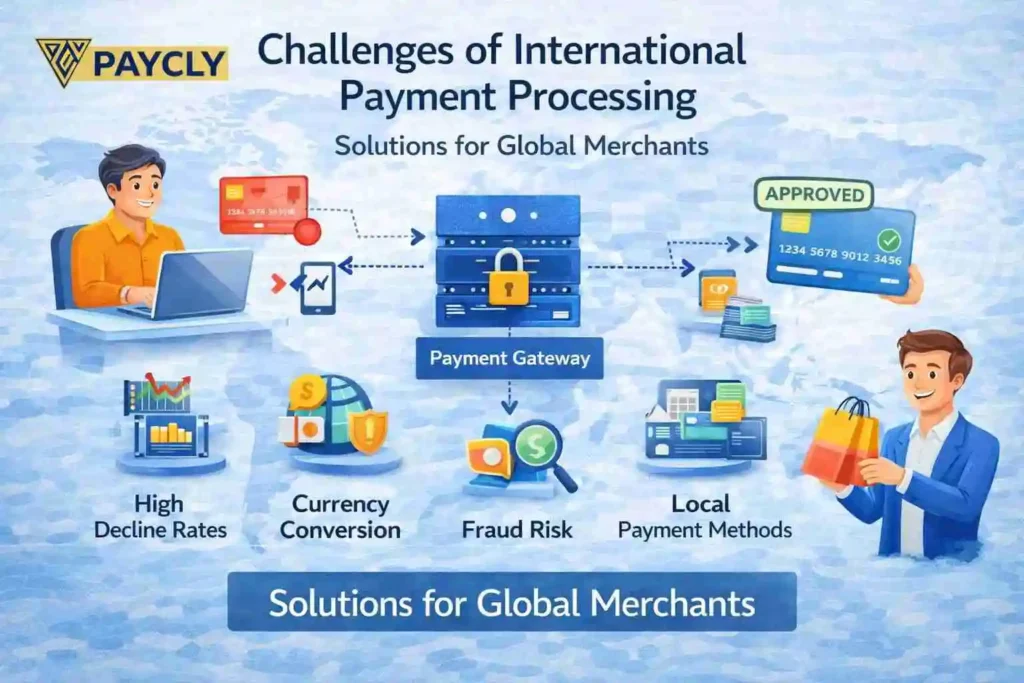
1. Higher Transaction Decline Rates
One of the biggest frustrations merchants face is the high number of declined international payments.
Cross-border transactions are often flagged by banks due to:
• Unfamiliar merchant location
• Currency mismatches
• Fraud prevention rules
• Card issuer restrictions
Businesses operating with high risk merchant accounts, such as gaming or digital services, often face even higher decline rates.
Solution
Using an international payment gateway with global acquiring capabilities can dramatically improve approval rates. By routing payments through regional banking partners, transactions appear more familiar to issuing banks.
2. Currency Conversion Issues
Customers prefer to see prices in their local currency. When they encounter unexpected currency conversions, they may hesitate to complete the purchase.
Additionally, fluctuating exchange rates can affect both merchant profits and customer trust.
Solution
Merchants should use a credit card payment solution that supports:
• Multi-currency pricing
• Real-time currency conversion
• Transparent exchange rates
This improves customer confidence and reduces abandoned transactions.
3. Fraud and Security Risks
Cross-border transactions are statistically more likely to trigger fraud alerts. Fraudsters often attempt to exploit international merchants using stolen card data.
Without strong security systems, businesses can experience:
• Chargebacks
• Fraud losses
• Account monitoring from banks
These risks are especially serious for industries requiring high risk payment processing.
Solution
A modern high risk payment gateway should include advanced fraud detection tools such as:
• AI fraud monitoring
• Behavioral transaction analysis
• Address verification systems
• Tokenization and encryption
These technologies help merchants balance security and customer convenience.
4. Regulatory Compliance Across Countries
Different countries enforce different financial regulations.
Merchants accepting international payments must consider:
• PCI-DSS security compliance
• Data privacy laws
• Regional payment rules
• Banking requirements
Failure to meet these standards can result in account suspensions or fines.
Solution
Working with a reliable online merchant account provider ensures compliance with global payment regulations while simplifying integration.
5. Limited Payment Method Support
Credit cards remain popular, but many regions rely heavily on Alternative Payment Methods.
Examples include:
• Digital wallets
• Local bank transfers
• Mobile payments
• Regional debit systems
Merchants who only support traditional cards may miss a large segment of global customers.
Solution
A comprehensive global payment processing system should support multiple payment options so businesses can accept credit card payments and alternative methods seamlessly.
6. Payment Processing for High-Risk Industries
Some industries face additional challenges due to higher fraud and regulatory risks.
Examples include:
• Forex merchant account businesses
• Casino merchant account platforms
• Adult merchant account websites
• Gaming merchant account operators
Banks often classify these sectors as high risk, making payment approvals more difficult.
Solution
Partnering with a provider that specializes in high risk merchant accounts helps businesses maintain stable payment processing and avoid unnecessary declines.
How the Right Payment Infrastructure Solves These Problems
The key to overcoming international payment challenges is choosing a payment partner that understands global commerce.
An advanced credit card merchant account and international payment gateway should provide:
1: Global acquiring banks
2: Multi-currency payment support
3: Smart payment routing
4: Fraud prevention tools
5: Alternative payment methods
6: Scalable APIs for integration
These capabilities allow merchants to expand globally while maintaining a smooth checkout experience.
Why Payment Experience Matters for Global Customers
Customers expect payments to be fast, secure, and familiar. When a checkout process feels complicated or risky, they quickly abandon the transaction.
By implementing a reliable credit card payment solution, businesses can ensure that customers from different countries can accept payment online without friction.
This not only improves conversion rates but also builds trust with international shoppers.
Final Thoughts
International expansion offers incredible opportunities for online businesses, but payment challenges can quickly become a barrier to growth.
From transaction declines and currency issues to fraud risks and compliance requirements, merchants must carefully choose their payment infrastructure.
By using a reliable international payment gateway and global payment processing solution, businesses can confidently accept payments from customers worldwide while maintaining security, compliance, and high approval rates.
In today’s global digital economy, the right payment partner is not just helpful—it’s essential.