
A multi-currency high-risk merchant account allows businesses in higher-risk industries to accept card payments from customers in different countries and currencies while managing the additional risks associated with international transactions. For businesses selling across the US, UK, Europe, Australia, Canada, Asia, and other markets, the right merchant account can make the difference between smooth international payment acceptance and constant payment disruptions.
For a high-risk business, going global is rarely as simple as switching on international payments.
A merchant may already be dealing with payment declines, rolling reserves, delayed settlements, chargebacks, fraud monitoring, transaction limits, account reviews, and higher processing fees. Adding multiple currencies and international customers can make those problems more difficult to manage.
This is where a properly structured high-risk merchant account for international payments becomes commercially important.
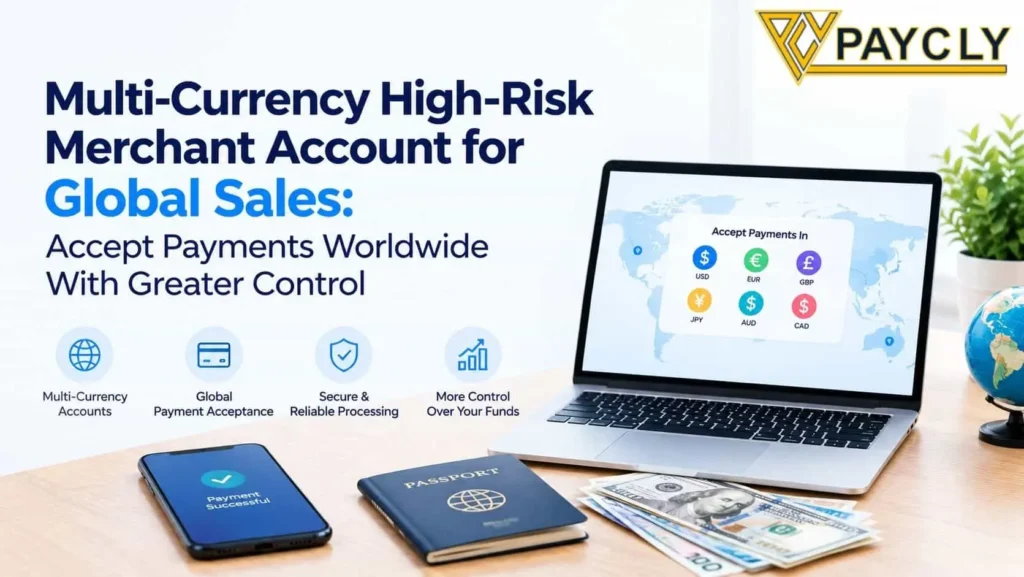
What Is a Multi-Currency High-Risk Merchant Account?
A multi-currency high-risk merchant account is a merchant processing arrangement designed for businesses that face elevated acquiring risk while allowing them to accept payments in multiple currencies.
Instead of restricting a merchant to one domestic payment market, a suitable setup can support transactions from international customers and may allow settlement in selected currencies, depending on the acquiring arrangement, business model, countries served, and provider capabilities.
Common currencies can include:
- USD
- EUR
- GBP
- CAD
- AUD
- CHF
- SGD
- AED
The exact currencies and settlement options depend on the acquiring bank, payment processor, merchant category, business location, customer geography, and underwriting requirements.
Global acquisition involves several stages, including authorization, settlement, currency conversion, fraud monitoring, compliance, and dispute management.
For high-risk merchants, therefore, the objective is not simply to accept international credit card payments. The objective is to build a payment structure that can handle international sales without creating unnecessary operational and financial pressure.
Why High-Risk Merchants Struggle With International Payments
International growth can expose weaknesses that are not always visible when a business operates in only one market.
A gaming operator, forex platform, adult-content business, subscription company, nutraceutical merchant, digital service provider, or other high-risk business may have a perfectly legitimate international customer base but still face stricter underwriting because of the risk profile associated with its industry.
Visa states that certain legal industries, including gambling and adult content, can carry elevated risk of illegal activity and therefore require enhanced safeguards and closer monitoring for acquiring relationships.
For the merchant, this can translate into practical problems.
Payment declines can increase
A customer may have a valid card and sufficient funds but still experience a declined transaction because of issuer fraud controls, geographic differences, currency considerations, merchant risk parameters, or other authorization factors.
For an international business, every unnecessary decline can mean a lost sale.
Fraud management has also become increasingly data-driven. Visa notes that merchants need to balance fraud prevention against false declines because blocking legitimate customers can also create revenue losses.
Rolling reserves can affect cash flow
One of the biggest frustrations for high-risk merchants is the rolling reserve.
A processor or acquiring partner may retain a percentage of processed funds for a defined period to cover potential chargebacks, refunds, or other liabilities.
For a growing merchant processing significant monthly volume, even a small reserve percentage can represent substantial working capital.
Imagine an online business processing $250,000 per month. A 10% reserve could temporarily place $25,000 outside the merchant’s immediate operating cash flow.
For businesses paying suppliers, advertising costs, affiliates, employees, refunds, and technology expenses, this can become a serious cash-flow challenge.
International chargebacks become harder to manage
Cross-border transactions can involve different consumer expectations, payment behaviors, currencies, regulations, and dispute processes.
Global acquiring providers commonly help merchants manage fraud, compliance, chargebacks, and currency conversion, but international transactions still create additional operational complexity.
For a high-risk merchant, a poorly managed chargeback ratio can lead to closer monitoring, additional reserves, higher costs, or even processing restrictions.
Currency conversion can reduce margins
Suppose a merchant advertises prices in EUR, receives customers from Europe, and ultimately settles funds in USD.
Currency conversion is then part of the payment lifecycle.
If the merchant operates across several markets, repeatedly converting funds between currencies can introduce additional FX costs and reconciliation complexity.
This is why multi-currency payment processing for high-risk businesses is about more than displaying different currency symbols at checkout.
How Multi-Currency Processing Helps Global Merchants
A properly structured multi-currency merchant account can give international businesses greater flexibility over how they accept and manage payments.
1. Accept customers in their preferred currency
Customers are generally more comfortable when checkout prices are presented in a familiar currency.
A European customer may prefer EUR. A UK customer may expect GBP. A Canadian buyer may want CAD.
Supporting local currencies can make the checkout experience easier to understand and can reduce uncertainty around the final transaction amount.
Visa’s global money movement infrastructure, for example, supports capabilities around collecting, holding, converting, and sending funds across currencies and markets.
2. Improve international payment operations
Without a suitable structure, merchants may need separate providers, gateways, bank accounts, or payment arrangements for different markets.
That can create a reconciliation nightmare.
A global payment setup can potentially consolidate parts of the payment operation while still providing access to different currencies and markets.
The exact structure depends on the merchant’s business model and acquiring partners.
3. Reduce unnecessary currency friction
A merchant that receives significant international revenue can benefit from having a more deliberate FX strategy instead of converting every transaction immediately.
Some global payment solutions support holding and managing funds across multiple currencies before conversion or payout.
For high-risk businesses with large international volumes, this can become particularly relevant to cash-flow planning.
4. Support international expansion
A business may begin with customers in one country and gradually expand into other regions.
A global high-risk merchant account can help businesses prepare their payment infrastructure for this expansion instead of rebuilding their processing arrangement every time they enter a new market.
However, merchants should confirm country availability, prohibited markets, MCC restrictions, settlement currencies, and underwriting requirements before expanding.
What Should High-Risk Merchants Look for in a Multi-Currency Merchant Account?
Not every international payment provider is suitable for a high-risk business.
Before choosing a provider, merchants should evaluate the complete payment structure rather than looking only at the headline transaction rate.
Multi-currency support
Check which currencies can actually be accepted and, importantly, which currencies can be used for settlement.
There is a major difference between displaying a currency at checkout and maintaining a payment and settlement structure that supports that currency.
High-risk underwriting experience
Ask whether the provider has experience with your specific business model.
A high-risk merchant account provider should understand the risks associated with your sector instead of treating every business as a standard e-commerce merchant.
Chargeback and fraud management
International growth should not mean accepting uncontrolled fraud exposure.
Look for tools and processes involving transaction monitoring, fraud screening, 3-D Secure where appropriate, dispute management, velocity controls, and suspicious-transaction monitoring.
Visa’s acquiring standards emphasize monitoring for unusual changes in transaction activity, sales volume, authorization attempts, and cross-border activity.
Transparent pricing
High-risk processing may involve several costs:
- Processing fees
- Gateway fees
- Cross-border fees
- Currency conversion charges
- Monthly fees
- Chargeback fees
- Reserve requirements
- Settlement fees
The lowest advertised processing rate is not necessarily the lowest total cost.
A merchant should calculate the effective payment processing cost across its actual transaction mix.
Settlement speed and reserve terms
Ask exactly when funds become available.
Also clarify:
- Reserve percentage
- Reserve duration
- Release conditions
- Settlement frequency
- Minimum settlement amounts
- Additional reserve triggers
These terms directly affect working capital.
Multi-Currency Payment Processing vs. Standard Merchant Accounts
A standard merchant account may work well for a low-risk business primarily serving one market.
A high-risk international business often needs a broader structure.
| Feature | Standard Merchant Account | Multi-Currency High-Risk Account |
| Domestic card acceptance | Usually | Yes |
| International payments | May be limited | Core requirement |
| Multiple currencies | Sometimes | Designed for it |
| High-risk industries | Often restricted | Specifically underwritten |
| Chargeback monitoring | Standard | Enhanced requirements may apply |
| Rolling reserve | Sometimes | More commonly considered |
| International settlement | Limited/varies | Depending on arrangement |
| Cross-border compliance | Standard | More complex |
| Fraud controls | Standard | Strong risk controls are important |
The actual terms vary by provider, acquirer, country, industry, and merchant risk profile.
Which High-Risk Businesses Can Benefit?
A multi-currency high-risk merchant account for global sales can be relevant to businesses such as:
1: Online gaming and gambling: International players, recurring deposits, withdrawals, chargeback exposure, and regulatory requirements can make payment acceptance particularly complex.
2: Forex and trading platforms: These businesses may receive customers from multiple jurisdictions and deal with substantial transaction values and heightened compliance requirements.
3: Adult businesses: Adult-content and related businesses can face enhanced acquiring requirements and monitoring even where their activity is legal. Visa specifically identifies legally operating adult-content merchants as a category that can require enhanced safeguards.
4: Subscription businesses: Recurring billing creates additional exposure around cancellations, disputes, and customer recognition of transactions.
5: Travel businesses: High-ticket transactions, delayed fulfillment, cancellations, refunds, and cross-border customers can increase payment risk.
6: Nutraceutical and wellness businesses: International shipping, recurring billing, product claims, and customer disputes can affect the risk profile.
7: Digital services: International customers, card-not-present transactions, and rapid global scaling can create additional fraud and dispute exposure.
How PayCly Can Support Global High-Risk Payment Needs
For a high-risk merchant, choosing a payment partner is not simply about getting a payment gateway.
The bigger question is whether the payment infrastructure fits the company’s industry, countries, currencies, transaction volumes, and risk profile.
PayCly focuses on high-risk merchant accounts, international payment processing, and payment solutions for businesses operating in sectors where traditional acquiring options may be more restrictive.
A suitable structure can help merchants explore multi-currency payment processing, international card acceptance, payment gateway integration, and risk-management requirements according to their business model.
Before applying, merchants should be prepared to provide accurate information about their company, ownership, products or services, expected processing volume, customer locations, website, refund policy, fulfillment process, and existing processing history.
Strong documentation matters because acquiring decisions are based on the overall risk profile rather than the business name alone.
What Documents Are Usually Needed?
High-risk merchants should expect a more detailed underwriting process.
Common requirements may include:
- Company incorporation documents
- Proof of business ownership
- Director or beneficial-owner identification
- Business bank statements
- Processing statements from existing providers
- Website and product information
- Refund and cancellation policies
- Terms and conditions
- Privacy policy
- Customer-support information
- Expected monthly processing volume
- Average transaction value
- Customer geography
- Supplier or fulfillment information
Providing complete and consistent information can make the underwriting process more straightforward.
Frequently Asked Questions
Q: What is a multi-currency high-risk merchant account?
It is a merchant account arrangement designed for businesses classified as high-risk that need to accept payments in multiple currencies and serve customers across international markets.
Q: Can high-risk merchants accept international credit card payments?
Yes, eligible high-risk merchants can accept international card payments when their acquiring and processing arrangements support the relevant business activity, countries, currencies, and compliance requirements.
Q: What currencies can a high-risk merchant account support?
Supported currencies vary by provider and acquiring arrangement. Common currencies include USD, EUR, GBP, CAD, AUD, CHF, SGD, and AED.
Q: Does a multi-currency merchant account eliminate chargebacks?
No. Multi-currency processing does not eliminate chargebacks or fraud. Merchants still need appropriate fraud prevention, transaction monitoring, customer communication, refund processes, and dispute management.
Q: Are multi-currency high-risk merchant accounts more expensive?
They can involve additional costs because international transactions may include cross-border, currency conversion, risk-management, and acquiring-related expenses. High-risk merchant accounts can also have higher fees or stricter terms than standard accounts.
Q: Can startups apply for a high-risk multi-currency merchant account?
Potentially. Approval depends on factors such as the business model, ownership, operating history, website, projected volume, processing history, geography, compliance controls, and the acquiring partner’s risk appetite.
Final Takeaway
Global sales create an opportunity for high-risk businesses, but international payment acceptance needs to be built around more than currency conversion.
Payment declines, rolling reserves, chargebacks, fraud exposure, delayed settlements, FX costs, account reviews, and complex compliance requirements can all affect a high-risk merchant’s ability to scale.
A well-structured multi-currency high-risk merchant account can give eligible businesses a more suitable foundation for accepting international payments while managing the operational realities of cross-border commerce.
For merchants planning expansion across multiple markets, the right approach is to evaluate currency support, acquiring coverage, settlement options, pricing, reserve requirements, fraud controls, chargeback management, compliance, and industry experience together.
If your business operates in a high-risk industry and needs to accept USD, EUR, GBP, CAD, AUD, or other international currencies, PayCly can help you explore a payment structure aligned with your business model and global sales strategy.
Ready to Accept Global Payments in Multiple Currencies?
Take the next step toward reliable multi-currency payment processing for your high-risk business. Talk to PayCly about international card acceptance, currency support, settlement options, and a payment setup built around your business model.
Contact PayCly today to explore your global high-risk merchant account options.