
As explored in The Future of High-Risk Payments Processing: Trends & Technologies Shaping 2026, selling globally is no longer reserved for large enterprises. In 2026, even niche digital businesses, subscription platforms, and high-risk industries operate across multiple regions from day one.
But as global reach expands, so does payment complexity.
Multi-currency acceptance and dynamic currency conversion (DCC) are no longer “advanced features.” They’ve become core expectations for businesses that want to accept payment online, improve conversions, and remain competitive in international markets.
For high-risk merchants accounts — including forex trading, online gaming, adult platforms, and dating services — the ability to manage currency friction efficiently can directly impact approval rates, chargebacks, and long-term growth.
Why Currency Friction Is a Silent Revenue Killer
Global customers don’t just care about whether a payment goes through — they care about clarity and trust at checkout. When prices are shown in unfamiliar currencies or converted unpredictably by banks, customers hesitate or abandon transactions entirely.
By 2026, businesses that rely on a single-currency checkout experience often see:
- Lower international conversion rates
- Higher refund requests due to pricing confusion
- Increased chargeback risk
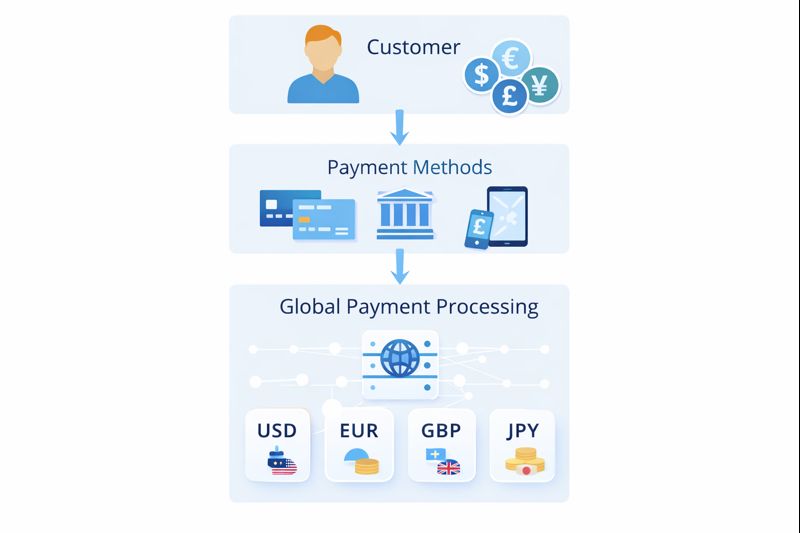
Multi-currency acceptance solves this problem by allowing customers to pay in their preferred currency, while dynamic currency conversion provides real-time exchange transparency at the point of sale.
For high-risk payment processing, reducing confusion isn’t just about UX — it’s about risk management.
What Multi-Currency Acceptance Really Means in 2026
Multi-currency acceptance is no longer limited to displaying prices in different currencies. In 2026, it involves a full payment ecosystem that supports:
- Localized pricing presentation
- Currency-specific authorization optimization
- Faster settlement in selected base currencies
- Reduced FX exposure for merchants
A modern international payment gateway must do more than convert amounts. It should intelligently route transactions, optimize approvals, and align with regional payment behavior — especially for global payment processing environments.
This capability is particularly important for businesses using high risk merchant accounts, where approval rates already face tighter scrutiny.
Dynamic Currency Conversion: Transparency at Checkout
Dynamic Currency Conversion (DCC) allows customers to see the final transaction amount in their local currency before completing payment. When implemented correctly, it builds trust and reduces post-transaction disputes.
In 2026, the role of DCC has expanded beyond convenience:
- It improves authorization confidence
- Reduces refund friction
- Supports compliance transparency
However, not all DCC implementations are equal. Poorly executed conversion logic can increase fees or create confusion — which is why DCC must be paired with a robust credit card payment solution and a reliable credit card merchant account.
Credit Cards Still Anchor Global Commerce
Despite the rise of wallets and instant payments, credit cards remain essential — particularly for recurring billing, subscriptions, and high-value transactions.
For businesses that accept credit card payments internationally, a flexible online merchant account combined with multi-currency support allows:
- Higher approval rates across regions
- Consistent billing for subscriptions
- Easier reconciliation and reporting
In high-risk verticals such as forex payment processing or online gaming, card stability is critical. But success in 2026 comes from pairing cards with additional payment options — not relying on them alone.
Alternative Payment Methods Complement Currency Flexibility
Alternative Payment Methods (APMs) have become a strategic layer in global payment stacks. Bank transfers, account-to-account payments, and wallet-based solutions often offer:
- Lower chargeback exposure
- Faster settlement times
- Stronger regional adoption
For gaming merchant accounts, casino merchant accounts, and adult merchant accounts, APMs help distribute risk and stabilize cash flow when card networks tighten controls.
In 2026, the most resilient payment infrastructures combine:
- Credit cards
- Local payment methods
- Multi-currency pricing
- Dynamic routing
This blended approach is now a best practice in High Risk Business Processing.
Currency Strategy Matters More for High-Risk Industries
High-risk businesses face unique challenges:
- Higher scrutiny from banks
- Cross-border regulatory complexity
- Volatile transaction patterns
For industries such as:
- Forex merchant accounts
- Gaming merchant accounts
- Online dating merchant accounts
currency flexibility isn’t optional — it’s essential.
Multi-currency acceptance helps reduce declines caused by foreign card mismatches, while DCC improves transparency for end users. Together, they lower operational friction and support sustainable growth.
Payment Orchestration Enhances Currency Performance
By 2026, many high-risk businesses no longer rely on a single processor. Instead, they use payment orchestration to dynamically route transactions based on currency, region, and risk profile.
This allows merchants to:
- Optimize authorization success
- Maintain uptime during provider disruptions
- Adjust FX strategies in real time
A high risk payment gateway with orchestration capabilities gives merchants greater control over both payments and currency exposure — a critical advantage in global markets.
Compliance, FX, and Trust Go Hand in Hand
Regulatory expectations around transparency and pricing clarity continue to rise. Clear currency display, predictable conversion logic, and accurate settlement reporting all contribute to compliance readiness.
In 2026, businesses that handle currency responsibly benefit from:
- Fewer disputes and refunds
- Stronger customer trust
- Smoother onboarding with payment partners
For companies operating under High Risk Merchant Account structures, this trust often determines how long and how smoothly processing relationships last.
What This Means for Global Merchants Moving Forward
Multi-currency acceptance and dynamic currency conversion are no longer competitive advantages — they are baseline requirements for global growth.
Merchants that succeed in 2026 will:
- Treat currency strategy as part of payment risk management
- Combine cards with alternative payment methods
- Choose payment partners that understand high-risk, cross-border complexity
At PayCly, the focus is on enabling businesses to accept payments online globally with clarity, flexibility, and confidence — regardless of industry classification or geographic reach.
FAQs:
1: What is multi-currency acceptance in payment processing?
Multi-currency acceptance allows customers to pay in their preferred local currency while merchants receive settlements in one or more base currencies. In 2026, this goes beyond simple currency display — it includes currency-aware authorization, localized pricing, and optimized routing through an international payment gateway. For global and high-risk businesses, multi-currency acceptance reduces checkout friction and improves approval rates.
2: How does dynamic currency conversion (DCC) work at checkout?
Dynamic currency conversion (DCC) shows customers the final transaction amount in their local currency before they complete payment. The exchange rate is applied in real time, providing pricing clarity and reducing post-payment disputes. When paired with a reliable credit card payment solution, DCC improves customer trust and lowers refund and chargeback risks — especially for cross-border and high-risk payment processing.
3: Is dynamic currency conversion good for merchants?
Yes — when implemented correctly. In 2026, DCC benefits merchants by increasing conversion confidence, improving transparency, and supporting compliance expectations. However, poor DCC setups can create confusion or unexpected fees. High-risk merchants should use DCC only through trusted payment partners that offer clear pricing logic and real-time FX controls.
4: Why is multi-currency support important for high-risk merchant accounts?
High-risk merchant accounts face stricter approval rules, higher scrutiny, and more cross-border declines. Multi-currency support helps reduce mismatches between card origin and transaction currency, which can improve authorization success. For industries such as forex trading, online gaming, adult platforms, and dating services, currency flexibility is a key factor in stabilizing approvals and managing payment risk.
5: Do credit cards still matter for global payments in 2026?
Absolutely. While alternative payment methods continue to grow, credit cards remain essential for subscriptions, recurring billing, and higher-value transactions. A well-structured credit card merchant account with multi-currency capability allows businesses to accept credit card payments globally while maintaining consistent billing, reporting, and settlement workflows.
6: How do alternative payment methods support multi-currency strategies?
Alternative Payment Methods (APMs) such as local bank transfers and wallet-based payments often handle currency conversion natively and carry lower chargeback exposure. In 2026, combining APMs with credit card processing allows high-risk businesses to diversify payment risk, reduce dependency on card networks, and improve regional acceptance.
7: Is multi-currency acceptance required for global expansion?
For most global-facing businesses, yes. In 2026, customers expect localized pricing and transparent currency handling as a standard checkout experience. Merchants that rely on single-currency processing often see lower conversion rates and higher support friction. Multi-currency acceptance is now a baseline requirement for scalable global payment processing.
9:How does PayCly support multi-currency and high-risk payments?
PayCly helps high-risk businesses build payment infrastructures that support multi-currency acceptance, dynamic currency conversion, and global payment processing. By combining secure credit card merchant accounts, alternative payment methods, and intelligent routing, PayCly enables merchants to accept payments online with clarity, compliance, and confidence across regions.
Ready to Simplify Global Payments?
As international commerce evolves, having the right payment infrastructure matters more than ever. From multi-currency support to secure high-risk payment processing, the right strategy can remove friction and unlock global growth.
If you’re exploring smarter ways to accept credit card payments, manage currency complexity, and scale internationally, working with a payments partner that understands high-risk businesses can make all the difference.