
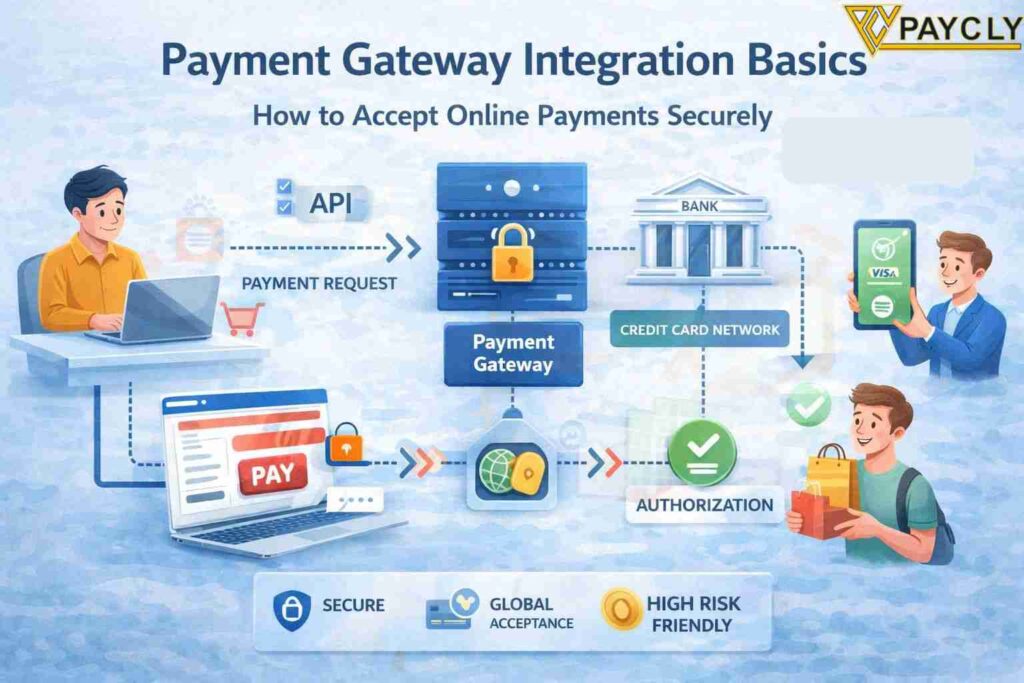
Accepting online payments looks simple on the surface. A customer enters card details, clicks “Pay,” and the transaction goes through. But behind that click sits a complex payment gateway integration that can either support your business growth—or silently limit it.
Many merchants struggle with failed transactions, high decline rates, compliance headaches, or sudden account freezes. In most cases, the problem isn’t demand. It’s the way the payment gateway is integrated.
This guide explains payment gateway integration basics, common merchant pain points, and how businesses—especially high-risk merchants—can integrate payments the right way.
What Is a Payment Gateway?
A payment gateway is the technology that securely connects your website or app with banks, card networks, and payment processors. It authorizes transactions, encrypts sensitive data, and ensures funds move safely from customer to merchant.
Without a proper Credit Card Payment Solution, merchants cannot:
- Accept payment online securely
- Scale to international customers
- Manage fraud and chargebacks
- Maintain long-term merchant account stability
Why Payment Gateway Integration Matters More Than Merchants Realize
Many businesses focus on pricing or design and overlook payment infrastructure. This leads to problems such as:
- High transaction declines
- Slow checkout experiences
- Compliance risks
- Payment processor flags
- Difficulty supporting Alternative Payment Methods
For industries using High Risk merchant accounts, these issues become more severe. Poor integration increases fraud exposure and makes processors more likely to terminate accounts.
Core Components of Payment Gateway Integration
1. Merchant Account Setup
Before integration, merchants need an approved Credit Card Merchant Account or online merchant account. This account determines:
- Processing limits
- Supported regions
- Risk tolerance
High-risk businesses—such as forex, gaming, or adult services—require specialized underwriting and a High risk payment gateway.
2. API or Hosted Checkout Integration
Merchants typically choose between:
- API-based integration (custom checkout control)
- Hosted payment pages (faster setup, less PCI burden)
API integrations offer better branding and user experience but require proper technical implementation to avoid security gaps.
3. Data Security & Compliance
Every gateway must protect card data using encryption and tokenization. Proper integration:
- Keeps merchants out of PCI scope
- Reduces data breach risk
- Protects customer trust
This is critical for businesses handling high risk payment processing or global payment processing.
4. Multi-Currency & International Support
If you serve customers across borders, your gateway must support:
- Multiple currencies
- Local acquiring
- International card networks
An international payment gateway reduces declines and improves authorization rates for global transactions.
Common Merchant Pain Points During Integration
❌ High Payment Declines
Often caused by:
- Incorrect API parameters
- Weak fraud rules
- Poor acquiring coverage
❌ Account Freezes or Terminations
Frequently linked to:
- Misclassified business models
- Unsupported transaction types
- Inadequate fraud controls
❌ Limited Payment Options
Merchants lose conversions when gateways fail to support:
- Digital wallets
- Bank transfers
- Alternative Payment Methods
Payment Gateway Integration for High-Risk Industries
Businesses using:
- Forex merchant accounts
- Gaming merchant accounts
- Casino merchant accounts
- Adult merchant accounts
require advanced integration with built-in risk monitoring, smart routing, and dispute management.
A standard gateway setup often fails under high-risk volumes, leading to blocked funds and merchant frustration.
How PayCly Simplifies Payment Gateway Integration
PayCly provides a secure, scalable payment infrastructure designed for both standard and high-risk businesses. Instead of forcing merchants into rigid setups, PayCly offers:
- Flexible API and hosted checkout options
- Built-in fraud monitoring and tokenization
- Support for global payment processing
- High-risk friendly underwriting
- Multi-currency and alternative payment support
Whether you need to accept credit card payments locally or expand internationally, PayCly’s integration adapts to your business model—not the other way around.
Best Practices for a Smooth Integration
- Choose a gateway aligned with your risk profile
- Test transactions thoroughly before launch
- Monitor decline and fraud ratios continuously
- Optimize checkout speed and mobile performance
- Work with a provider that understands your industry
Final Thoughts
Payment gateway integration is not just a technical step—it’s a business decision that affects revenue, compliance, and long-term growth.
Merchants who invest in the right Credit Card Payment Solution avoid unnecessary disruptions, reduce fraud exposure, and create smoother customer experiences.
With PayCly, businesses gain a payment gateway built for scale, security, and real-world merchant challenges—especially where traditional providers fall short.