
Credit card processing for offshore companies gives internationally focused businesses a practical way to accept credit card payments from customers across multiple markets. For companies selling to customers in the United States, United Kingdom, Canada, Europe, Australia, Singapore, and the United Arab Emirates, choosing the right Credit Card Payment Solution can directly affect payment acceptance, settlement speed, cash flow, and customer experience.
For offshore businesses, however, getting access to card processing is only one part of the challenge. The bigger question is whether the payment infrastructure can support international customers, multiple currencies, chargebacks, fraud monitoring, recurring billing, compliance reviews, and increasing transaction volumes.
This becomes even more important for high-risk businesses. An offshore company operating in adult, gaming, forex, nutraceuticals, supplements, subscriptions, digital services, travel, or other higher-risk sectors may face additional underwriting requirements and tighter risk controls.
A well-structured offshore payment setup can support international growth. A poorly matched one can result in declined applications, excessive reserves, delayed settlements, or even account termination.
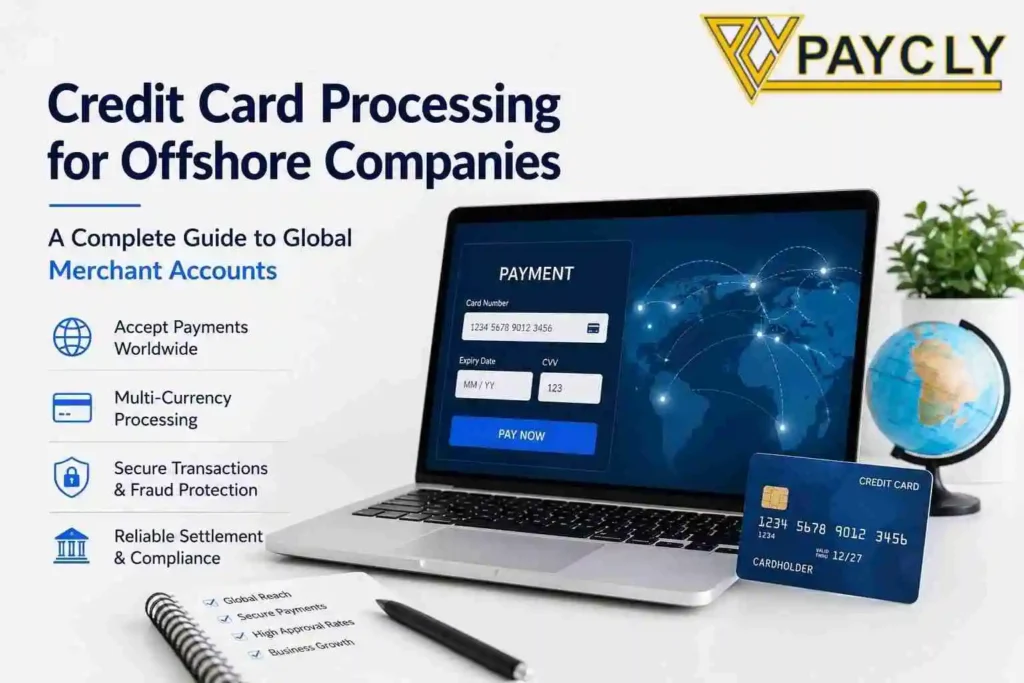
What Is Credit Card Processing for an Offshore Company?
Credit card processing allows an offshore or internationally incorporated company to accept card transactions through an acquiring relationship and payment gateway.
The basic transaction flow is:
Customer → Payment Gateway → Acquirer → Card Network → Issuing Bank → Settlement
An offshore structure can make this process more complex because several factors may be reviewed during underwriting. These can include the company’s incorporation country, operating location, customer geography, transaction currencies, products or services, expected processing volume, and industry risk.
A Credit Card Merchant Account is the acquiring-side arrangement that enables an eligible business to process card transactions and receive settlements. A payment gateway, meanwhile, provides the technology that securely transmits transaction information.
This distinction matters when comparing providers. A company offering a gateway is not necessarily the acquiring institution providing the underlying merchant account.
For businesses operating internationally, a complete setup may include:
- International card acceptance
- Multi-currency processing
- Payment gateway integration
- Fraud screening
- 3D Secure authentication
- Chargeback management
- Recurring billing
- Transaction monitoring
- Cross-border settlement
- Payment reporting and reconciliation
The exact services available depend on the provider, acquiring bank, business model, and jurisdiction.
Why Offshore Businesses Struggle With Card Processing
One of the biggest misconceptions about offshore payment processing is that incorporating a company in another jurisdiction automatically makes international card acceptance easier.
It does not.
Underwriters want to understand how the business actually operates.
For example, a company may be incorporated in one jurisdiction, have directors based elsewhere, target customers in the United States and Europe, and use suppliers located in several different countries. This structure can be legitimate, but the payment provider needs a clear understanding of the company’s ownership, operations, customer base, and flow of funds.
For high-risk merchants, scrutiny can be even greater.
Businesses operating in industries such as online gaming, adult, forex, gambling, supplements, nutraceuticals, subscriptions, digital services, and other high-risk categories can face more detailed underwriting.
The first problem often appears during onboarding.
A merchant may spend days gathering incorporation documents, identification, bank statements, processing history, website information, ownership records, and compliance documents. After submitting everything, the application may still be declined because the acquiring partner does not support the business category or jurisdiction.
Getting approved is also not the same as maintaining a stable account.
As transaction volume grows, a merchant may experience additional transaction monitoring, reserve increases, payout delays, or further underwriting reviews. Visa’s acquiring risk standards, for example, describe monitoring changes in merchant creditworthiness and business activity and allow for measures such as additional reviews, reserve changes, holds, or revised settlement procedures where appropriate.
For a growing offshore business, this distinction can have a major effect on working capital.
The Biggest Payment Challenges for High-Risk Offshore Merchants
Difficult Underwriting
High-risk merchants rarely receive the same straightforward onboarding experience as low-risk e-commerce businesses.
An acquiring partner may want information about the company’s ownership, products, customer locations, expected transaction volume, average ticket size, refund policy, fulfillment process, and previous processing history.
For offshore companies, inconsistencies between corporate documents, the website, bank account, and actual operations can create additional questions.
The best approach is transparency. Merchants should clearly explain what they sell, who their customers are, where transactions originate, and how funds move through the business.
Rolling Reserves and Held Funds
Rolling reserves are another major concern for high-risk businesses.
Consider an offshore e-commerce company processing $150,000 each month. Revenue may be growing quickly, but if part of each settlement is placed into a reserve, the merchant has less working capital available for advertising, suppliers, payroll, fulfillment, and refunds.
This is why merchants evaluating offshore high risk merchant accounts should ask detailed questions about reserve percentages, release periods, reserve triggers, and conditions that can cause the reserve to change.
A lower processing rate does not necessarily compensate for a payment structure that restricts too much working capital.
Chargebacks and Customer Disputes
Chargebacks can be particularly expensive for high-risk merchants because they affect both revenue and the merchant’s risk profile.
Customers may fail to recognize an international billing descriptor, misunderstand a recurring subscription, dispute a digital purchase, or report an unauthorized transaction.
Mastercard explains that chargeback ratios are used to assess merchant risk and that excessive chargebacks can contribute to additional costs and restrictions.
That makes prevention essential.
Clear billing descriptors, transparent refund policies, customer communication, fraud screening, transaction records, and effective dispute management can help reduce avoidable chargebacks.
Declined Transactions
A merchant can lose revenue without receiving a chargeback.
A legitimate customer might enter card details, receive a decline, try again, and eventually leave the website. The merchant loses the sale without necessarily knowing why.
International transactions can introduce additional variables, including issuer behavior, currency differences, authentication requirements, cardholder location, and fraud signals.
Modern payment infrastructure uses transaction-level risk analysis to help distinguish legitimate customers from suspicious activity. Visa, for example, describes real-time transaction monitoring and risk scoring designed to improve authorization decisions while reducing fraud and chargebacks.
For an offshore business, improving the quality of authorization can therefore be more valuable than simply increasing the number of payment attempts.
Offshore Merchant Account vs. Payment Gateway
These terms are often confused.
An offshore merchant account is the acquiring-side relationship that allows an eligible business to process card transactions and receive settlements.
A payment gateway is the technology layer that securely transmits payment information between the merchant and payment-processing infrastructure.
An offshore company may need both.
For example, a high-risk e-commerce merchant could use a specialist merchant account together with a gateway that supports tokenization, recurring payments, 3D Secure, fraud screening, and multiple currencies.
This distinction becomes particularly important when evaluating international merchant account providers. A provider may advertise international payment processing but have limitations on specific industries, countries, currencies, or transaction types.
Merchants should always confirm what is actually included in the proposed payment structure.
What to Look for in an Offshore Credit Card Processor
Choosing a provider based solely on processing rates can be a costly mistake. Businesses should assess the entire payment infrastructure.
Multi-Currency Processing
If customers are located across the U.S., U.K., Canada, Europe, and other major markets, multi-currency capabilities can make collections and settlements easier to manage.
A merchant should understand which currencies can be accepted, which currencies can be settled, and what foreign-exchange costs may apply.
Support for High-Risk Businesses
Not every offshore provider accepts every high-risk industry.
Before submitting an application, confirm that the provider supports the exact business model. A company processing gaming transactions, for example, should not assume that a provider accepting “high-risk e-commerce” will automatically support gambling or gaming.
Fraud and Chargeback Management
Look for appropriate tools such as 3D Secure, AVS, CVV verification, tokenization, transaction monitoring, fraud scoring, and dispute management.
The objective is not to eliminate every fraudulent transaction. It is to create a payment environment that balances fraud prevention with legitimate customer acceptance.
Transparent Reserve Terms
Merchants should understand exactly how reserves operate.
Ask about the percentage, release schedule, duration, triggers for increases, and what happens if transaction volume changes unexpectedly.
Stable Settlement
Settlement speed directly affects cash flow.
Businesses should review payout schedules, settlement currencies, bank requirements, transaction limits, and circumstances that could trigger a review or temporary hold.
This is particularly important for businesses using global merchant payment services, where incoming customer payments and outgoing international business expenses may occur across different currencies and jurisdictions.
Scalability
Payment infrastructure should be capable of handling growth.
A company processing $20,000 per month may eventually reach $100,000, $250,000, or more. If the original payment setup cannot accommodate that growth, the merchant may face additional reviews or operational disruption.
A good provider should understand the expected growth trajectory before processing volume increases.
Security and Compliance
Offshore does not mean exempt from payment security requirements.
PCI DSS provides technical and operational requirements for entities involved in storing, processing, or transmitting payment card data.
Even when payment processing is outsourced, merchants can still have responsibilities regarding their service providers and the protection of payment data.
Businesses should therefore evaluate the security practices, compliance responsibilities, data handling, and contractual obligations associated with their chosen provider.
How to Improve Your Offshore Merchant Account Approval Chances
A strong application starts with accurate information.
Before applying for an offshore merchant account USA, businesses should prepare:
- Certificate of incorporation and corporate documents
- Ownership and director information
- Required identification documents
- Business bank statements
- Previous processing statements
- Website and product information
- Refund and cancellation policies
- Expected monthly processing volume
- Average transaction value
- Customer locations
- Fulfillment or delivery information
- Required licenses or regulatory documentation
- A clear explanation of the business model
Do not deliberately underestimate expected transaction volume.
If an application indicates $20,000 in monthly processing but actual transactions quickly reach $200,000, the difference can attract additional underwriting attention.
A transparent application gives the acquiring partner a more accurate picture of the expected risk.
Why the Cheapest Offshore Processing Rate Can Backfire
Processing fees are important, but they should never be the only metric.
Suppose one provider offers a slightly lower transaction rate but has weaker authorization performance, slower settlements, higher reserve requirements, or limited fraud controls.
The merchant may save a fraction of a percentage point while losing significantly more through declined transactions, tied-up capital, and missed sales.
Experienced merchants therefore compare offshore credit card processing fees alongside:
- Authorization performance
- Chargeback exposure
- Reserve requirements
- Settlement speed
- Currency conversion costs
- Gateway fees
- Refund costs
- Fraud-prevention tools
- Transaction limits
- Contract terms
The cheapest processor is not always the most cost-effective payment partner.
Can Offshore Companies Accept Credit Card Payments?
Yes, eligible offshore companies can accept credit card payments, but approval depends on factors such as the business model, jurisdiction, ownership structure, customer geography, products or services, transaction profile, and acquiring partner.
An offshore structure should never be treated as a way to avoid underwriting or regulatory requirements.
Visa notes that acquirers serving merchants in higher-risk areas must have appropriate oversight of merchant compliance and can take action where potentially illegal activity is identified.
For legitimate businesses, offshore processing can instead provide a structured way to serve international customers when the payment arrangement is properly designed and compliant.
Is Offshore Credit Card Processing Right for Your Business?
An offshore payment structure may be commercially useful for legitimate companies with international operations, particularly when domestic acquiring options do not match their jurisdiction, customer base, or industry.
It can be relevant to international e-commerce businesses, subscription companies, digital services, marketplaces, and other merchants operating across several markets.
However, the objective should not simply be to find a provider willing to approve the account.
The objective should be to find a Credit Card Payment Solution that can support the complete payment lifecycle—from underwriting and authorization to settlement, reconciliation, fraud management, and international expansion.
For high-risk businesses, this means evaluating offshore high risk merchant accounts based on stability, transparency, compliance, scalability, and access to suitable acquiring infrastructure.
Looking for a Reliable Offshore Credit Card Payment Solution?
Finding suitable international payment processing services can be difficult when a business operates across jurisdictions or belongs to a high-risk industry.
If your company is dealing with declined applications, payment holds, restrictive reserves, chargebacks, or limited international card acceptance, it may be time to review your existing payment structure.
PayCly helps eligible international and high-risk businesses explore tailored merchant account and payment processing solutions based on their business model, target markets, transaction volume, and risk profile
If you are evaluating international merchant account providers, need a Credit Card Merchant Account, or are exploring global merchant payment services, contact PayCly to discuss your requirements and identify a payment structure designed for sustainable international growth.
Final Thoughts
Credit card processing for offshore companies can provide legitimate international businesses with a practical way to accept card payments and expand into new markets.
But the strongest solution is not simply the provider offering the easiest approval or lowest headline rate.
For high-risk merchants, the priorities should be reliable authorization, effective fraud controls, manageable chargebacks, predictable settlements, transparent reserve policies, multi-currency capabilities, payment security, and an acquiring relationship that understands the business model.
A well-structured offshore payment operation should support the merchant throughout its entire lifecycle—from application and transaction authorization to settlement, reconciliation, dispute management, and international expansion.
That is what turns offshore card processing from a short-term workaround into a sustainable global payment strategy.