
The UAE has become an important hub for e-commerce, digital services, financial technology, and cross-border business. For an online merchant, that creates a significant opportunity—but also a practical payment challenge.
Customers expect fast, secure, and familiar checkout experiences. Businesses want reliable authorization, predictable settlements, multiple currencies, and access to customers outside the UAE. For merchants in higher-risk industries, the challenge is even greater.
A business may have a strong product and growing demand but still struggle with payment declines, account reviews, rolling reserves, chargebacks, limited acquiring options, or difficulty finding a suitable merchant account.
That is why choosing the right payment gateway for online businesses in UAE should be treated as a commercial decision rather than simply a technical integration.
The UAE Central Bank regulates retail payment services in the country, including merchant acquiring, payment aggregation, and domestic and cross-border fund transfer services. Payment service providers operating within the relevant regulatory framework are subject to licensing and ongoing obligations.
For businesses selling locally and internationally, the right payment infrastructure needs to balance conversion, risk management, compliance, settlement, and scalability.
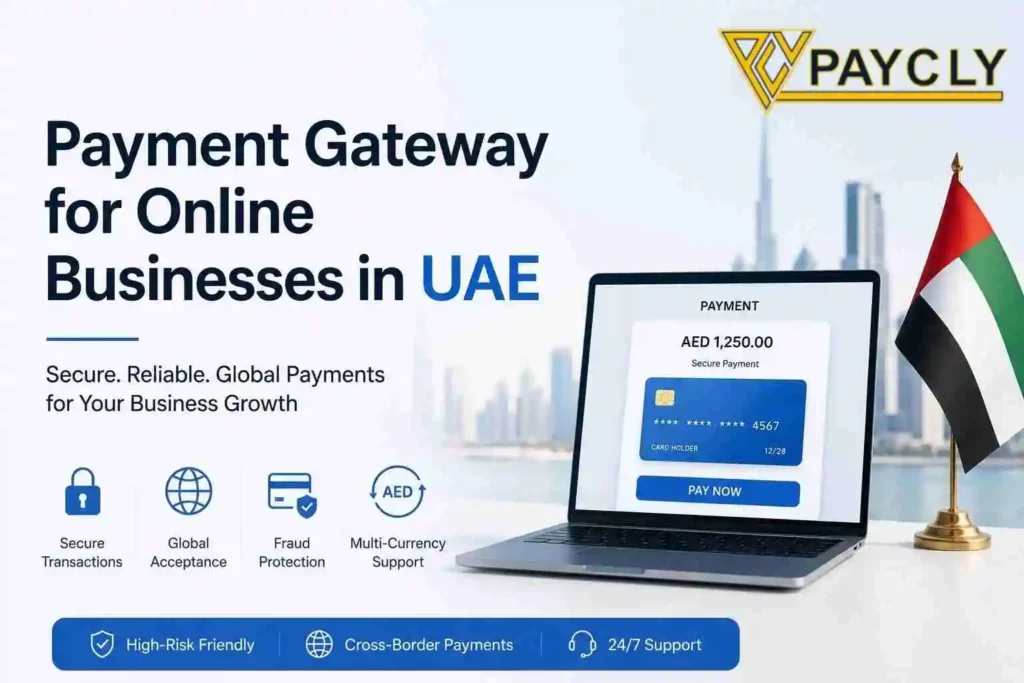
What Is a Payment Gateway for an Online Business in the UAE?
A payment gateway is the technology that connects an online checkout with the payment-processing and banking infrastructure required to authorize a transaction.
The UAE’s regulatory materials describe a payment gateway as a system that processes, accepts, or declines payment transactions on behalf of a merchant through secure network connections.
In practical terms, the customer enters payment information at checkout. The gateway securely transmits the transaction information, connects with the relevant payment-processing infrastructure, and returns an approval or decline response.
But a gateway is only one part of the payment ecosystem.
An online merchant may also need:
- A merchant account
- An acquiring relationship
- Fraud and risk controls
- 3D Secure authentication
- Tokenization
- Recurring billing
- Multi-currency processing
- Alternative payment methods
- Chargeback management
- Settlement and reporting tools
This is why merchants searching for a merchant account with payment gateway should evaluate the complete payment structure rather than choosing a gateway based solely on its checkout interface.
Why UAE Online Businesses Need More Than a Basic Payment Gateway
A conventional online store selling primarily within one market may have relatively straightforward payment requirements.
A growing UAE business can have a much more complicated profile.
It may sell to customers in Saudi Arabia, the UK, Europe, India, Singapore, the United States, or other markets. Customers may want to pay in different currencies and use different payment methods.
At the same time, the merchant needs to manage fraud, chargebacks, refunds, authentication, settlement, and compliance.
The UAE itself has a sophisticated payment infrastructure. The Central Bank operates systems including the UAE Payment Gateway System (UAEPGS), while its broader payments strategy focuses on safe, efficient, innovative, and convenient digital payments.
For businesses with international ambitions, however, domestic payment capability may only be the starting point.
High-Risk Merchants Face a Different Payment Reality
One of the biggest challenges in the UAE payment market is faced by businesses that banks and processors classify as high risk.
Examples can include:
- Forex and trading platforms
- Gaming and iGaming
- Online casinos
- Adult businesses
- Dating platforms
- Subscription businesses
- Certain nutraceutical businesses
- Digital products
- Specialized e-commerce
These merchants can experience more stringent underwriting because their payment profiles may involve higher chargeback exposure, fraud risk, regulatory complexity, international transactions, or unusual transaction volumes.
For these businesses, simply searching for the cheapest payment gateway can be counterproductive.
A High risk payment gateway is designed around the additional payment and risk-management requirements that can arise from higher-risk business models.
The objective isn’t to bypass compliance. It is to find payment infrastructure capable of evaluating and supporting the merchant’s legitimate business model.
What Problems Are High-Risk Merchants Facing?
A common scenario looks like this:
A merchant launches successfully and starts generating sales. Processing initially works well. Marketing expenditure increases, international customers begin arriving, and monthly transaction volume rises.
Then the payment provider requests additional documentation.
Settlement conditions change.
A reserve is introduced.
Decline rates increase.
Eventually, the merchant may face a processing restriction or account review.
For a high-risk business, these problems can create serious cash-flow pressure.
If funds are held while advertising, payroll, suppliers, technology costs, and customer refunds continue, growth can become difficult to sustain.
This is why a High-risk payment gateway should be evaluated not only on whether it can process transactions today, but also on whether its infrastructure and acquiring relationships are appropriate for the merchant’s expected growth.
International Payment Processing Matters in the UAE
The UAE is particularly attractive for businesses with an international customer base.
That makes an international payment gateway an important consideration for merchants that don’t want their payment strategy limited to domestic transactions.
An international gateway can support businesses that need to process payments across different countries and currencies, subject to the provider’s supported markets, acquiring relationships, underwriting, and compliance requirements.
PAYCLY states that its international payment infrastructure supports merchants across 150+ countries and 100+ currencies, alongside payment methods and cross-border e-commerce capabilities.
For a UAE-based online business, this type of infrastructure can be relevant when international sales become a significant part of revenue.
The key question is not simply:
“Can this gateway accept international cards?”
It is:
“Can this payment infrastructure support my customers, currencies, risk profile, and settlement requirements as I expand?”
Why Cross-Border Payment Infrastructure Is Important
International expansion introduces additional complexity.
A merchant may have:
- UAE-based operations
- Customers in multiple countries
- Multiple settlement currencies
- International cardholders
- Local payment-method requirements
- Cross-border transaction fees
- Different fraud patterns
- Different regulatory considerations
That is why cross-border payment gateway solutions should be assessed according to the merchant’s actual markets.
For example, a business targeting customers across the GCC may need different payment capabilities from a business selling to customers throughout Europe or North America.
A strong international ecommerce payment gateway should therefore be assessed for currency support, payment-method availability, transaction routing, reporting, authentication, fraud management, and settlement.
Choosing a Payment Gateway for UAE E-Commerce
Before signing with a provider, consider these seven factors.
1. Merchant Account Compatibility
A gateway alone does not necessarily give a merchant the ability to accept card payments.
Ask whether the provider offers or connects you with an appropriate merchant account with payment gateway infrastructure.
The relationship between the gateway, merchant account, processor, and acquiring bank should be clear before onboarding.
2. Supported Currencies
If your customers are international, local-currency payment acceptance can become an important part of the checkout experience.
PAYCLY states that its platform supports 100+ international currencies.
Merchants should still confirm which currencies are available for their specific business, markets, and settlement arrangement.
3. Payment Methods
Cards remain important, but international customers may prefer local payment methods, bank-based payments, digital wallets, or other alternatives.
The broader the target market, the more important payment-method coverage becomes.
4. Fraud Prevention
A payment gateway should not be judged only by its ability to approve transactions.
Fraud prevention, authentication, transaction monitoring, tokenization, and chargeback controls are equally important.
PAYCLY describes fraud-management capabilities including AI/ML-based fraud prevention, chargeback management, and tokenization within its high-risk payment offering.
5. International Acquiring
Ask where transactions are acquired, which countries are supported, and how settlement works.
This becomes particularly important for merchants looking for worldwide payment gateway solutions rather than a payment setup limited to a single domestic market.
6. Integration and Reporting
A modern gateway should fit the merchant’s technology stack.
Look for API capabilities, checkout integration, reporting, transaction notifications, refunds, recurring billing where appropriate, and reconciliation tools.
PAYCLY states that its platform provides API integration, checkout integration, plug-ins, and reporting functionality.
7. Risk and Underwriting
The merchant should understand the provider’s approach to reserves, transaction limits, chargebacks, prohibited activities, settlement, and account reviews.
This is particularly important for high-risk industries.
Specialized Payment Gateways for High-Risk Industries
Different businesses can have very different payment requirements.
A forex platform, for example, may need a forex broker payment gateway capable of handling international transactions, higher transaction values, and the specific underwriting requirements associated with financial trading businesses.
Similarly, gaming operators may need gaming payment gateway solutions that support international customers, fraud controls, authentication, and appropriate payment methods.
Businesses operating across multiple gaming markets may also evaluate global gaming payment gateways to support international transaction flows.
For adult businesses, finding an adult ecommerce payment gateway can be more difficult because many mainstream providers apply restrictions or enhanced underwriting to the category.
Dating platforms can face similar challenges when looking for a dating site payment gateway, particularly where recurring billing, international customers, disputes, and fraud are involved.
These examples illustrate an important point: payment infrastructure should match the business model.
A gateway that works perfectly for a low-risk apparel retailer may not be suitable for a forex, gaming, adult, or dating business.
Why High-Risk Businesses Shouldn’t Choose on Price Alone
Processing rates matter, but they aren’t the complete cost of accepting payments.
A merchant should consider:
- Processing fees
- Gateway fees
- Chargeback fees
- Cross-border costs
- Currency-conversion costs
- Reserve requirements
- Declined transactions
- Failed recurring payments
- Refund costs
- Payment downtime
- Lost revenue from checkout friction
A slightly higher processing rate can potentially be commercially preferable if the overall payment infrastructure delivers better authorization, stability, international coverage, and risk management.
For a high-risk merchant, payment continuity can be more valuable than the lowest advertised rate.
PAYCLY for UAE and International Online Businesses
For businesses evaluating an international payment gateway, PAYCLY positions its platform around global and high-risk payment processing.
Its published offering includes international payment processing, multi-currency capabilities, alternative payment methods, dedicated merchant infrastructure, fraud-management tools, and specialized solutions for high-risk industries.
The company also lists gaming, forex, casino, e-commerce, and other high-risk industries among its payment solutions.
For a UAE merchant, the relevant question is whether the provider’s available acquiring arrangement, supported countries, currencies, payment methods, underwriting requirements, and settlement terms fit the specific business.
No payment provider is automatically appropriate for every merchant. Eligibility and availability depend on the business model and applicable requirements.
What Should You Ask a UAE Payment Gateway Provider?
Before applying, ask direct commercial questions:
Q: Can you support my industry?
If you’re operating a high-risk business, confirm that the provider actually underwrites your category.
Q: Which countries can I process in?
Don’t assume that “global” means every country or every transaction type is supported.
Q: Which currencies are available?
Confirm both processing currencies and settlement currencies.
Q: What payment methods can my customers use?
This matters particularly for businesses targeting customers outside the UAE.
Q: How are chargebacks and fraud handled?
Understand what tools and support are included.
Q: What are the reserve and settlement terms?
This can have a major effect on cash flow.
Q: Can the infrastructure scale with my transaction volume?
A payment setup should not become a bottleneck when sales increase.
Final Takeaway
Finding the right payment gateway for online businesses in UAE is about much more than adding a checkout button to a website.
For a growing business, the payment infrastructure needs to support authorization, fraud prevention, settlement, international transactions, multiple currencies, and customer payment preferences.
For high-risk merchants, the decision becomes even more important. A suitable High risk payment gateway can provide a payment structure better aligned with the merchant’s industry and risk profile, while an international payment gateway can support expansion into new markets.
Whether you need an international ecommerce payment gateway, cross-border payment gateway solutions, a merchant account with payment gateway, or specialized infrastructure such as a forex broker payment gateway, gaming payment gateway solutions, adult ecommerce payment gateway, or dating site payment gateway, the right approach is to evaluate the complete payment ecosystem rather than a single processing rate.
For UAE-based businesses planning international growth, payment processing should be treated as part of the growth strategy from day one.
Ready to explore a payment gateway for your UAE business? Contact PAYCLY to discuss your industry, target markets, transaction profile, currencies, and payment-processing requirements.