
Hosted vs Integrated Payment Gateways. Once you understand what a payment gateway does, the next big question usually sounds like this:
“Should I send customers to a payment page… or keep them on my website?”
This is where most online businesses get stuck.
You may already have customers ready to pay, but the wrong checkout setup can quietly reduce conversions, raise trust issues, or create technical headaches you didn’t plan for.
Let’s break this down in plain terms.
The Real Problem Merchants Face at Checkout
Many business owners focus on getting traffic first.
Checkout comes later — and that’s where things often fall apart.
Common complaints we hear:
- Customers abandoning payment pages
- Payment pages that “look different” from the website
- Developers asking too many technical questions
- Fear of handling card data directly
- Confusion between gateway features and pricing
Most of this confusion comes down to two checkout types:
- Hosted payment gateways
- Integrated payment gateways
What Is a Hosted Payment Gateway?
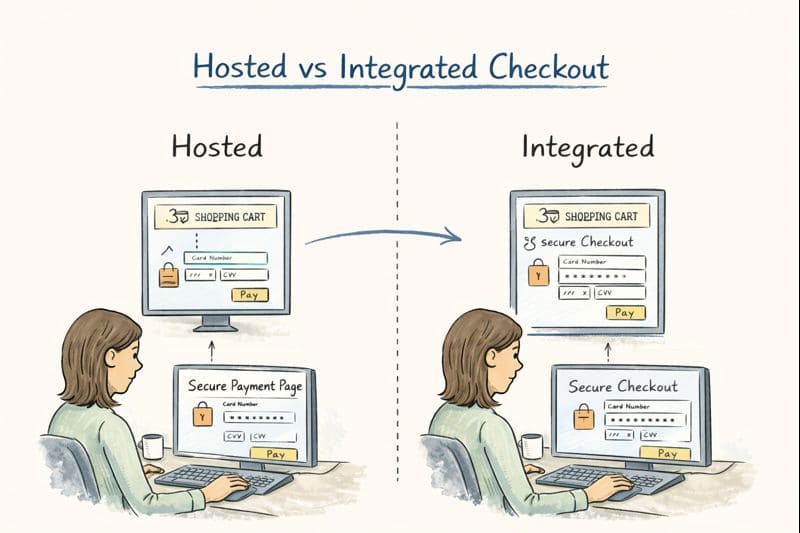
A hosted payment gateway redirects customers away from your website to a secure payment page managed by the gateway provider.
How it works
- Customer clicks “Pay” on your website
- They’re redirected to a secure payment page
- Card details are entered there
- After payment, the customer is sent back to your site
Why merchants choose hosted gateways
- No need to store or process card data
- Faster setup
- Lower security responsibility
- Minimal technical work
For many small businesses, this feels like the safest option.
Where hosted gateways fall short
- Customers notice the redirect
- Branding may not fully match your site
- Some users hesitate when redirected
- Less control over checkout experience
Hosted gateways are simple — but simple doesn’t always mean flexible.
What Is an Integrated Payment Gateway?
An integrated payment gateway keeps the entire payment process on your website.
Customers enter their card details directly on your checkout page, even though the transaction is securely processed by the gateway behind the scenes.
How it works
- Customer stays on your checkout page
- Card details are entered on your site
- Payment is processed securely in the background
- Confirmation happens instantly
Why merchants prefer integrated gateways
- Seamless checkout experience
- Strong brand consistency
- Higher trust for returning customers
- Better conversion control
This option feels more professional — especially for growing online businesses.
Where integrated gateways can be challenging
- Requires technical integration
- Security compliance matters
- Setup takes longer
- Ongoing maintenance may be needed
Integrated gateways offer control, but they demand responsibility.
Hosted vs Integrated Payment Gateway: Which One Is Right for Your Business?
| Feature | Hosted Gateway | Integrated Gateway |
| Customer stays on site | ❌ No | ✅ Yes |
| Setup complexity | Low | Medium to High |
| Security responsibility | Gateway handles it | Shared responsibility |
| Custom branding | Limited | Full control |
| Conversion optimization | Limited | Strong |
Which One Solves Your Problem?
Instead of asking which is better, ask:
Choose a hosted gateway if:
- You’re just starting out
- You don’t have a technical team
- You want the fastest approval and setup
- Security concerns keep you up at night
Choose an integrated gateway if:
- You want higher conversion rates
- Your brand trust matters
- You sell regularly, not occasionally
- You can handle or outsource technical setup
There’s no wrong choice — only a wrong fit.
Common Mistakes Merchants Make
- Choosing based on price alone
- Ignoring checkout experience
- Not testing customer flow
- Overestimating technical capacity
- Assuming one solution fits every business
Your checkout is not just a payment form — it’s the final step of trust.
Final Thoughts
Once you understand what a payment gateway is, choosing how it appears to your customers becomes just as important as choosing the provider itself.
Hosted gateways offer safety and speed.
Integrated gateways offer control and growth.
The right choice depends on where your business is today — and where you want it to go next.In the next step, merchants usually start asking about fees, approvals, and transaction failures — because understanding payments doesn’t stop at checkout design.