
International Merchant Account with Multi-Currency Settlement solutions help global businesses accept payments from international customers while managing currency conversion, settlement arrangements, and cross-border payment costs. For companies expanding into the United States, the United Kingdom, Europe, and the United Arab Emirates, choosing the right international merchant account can improve payment flexibility and support sustainable growth.
However, international payment processing is not equally accessible to every business. High-risk merchants, including forex brokers, online gaming operators, adult businesses, subscription companies, and certain travel and nutraceutical businesses, often face additional underwriting requirements, higher processing fees, rolling reserves, and restricted settlement options.
For these businesses, accepting international payments is only one part of the challenge. They also need predictable access to funds, transparent pricing, effective fraud prevention, and settlement options that match their operational requirements.
PayCly helps businesses explore international payment-processing solutions, including multi-currency payment capabilities, for cross-border commerce. Understanding how multi-currency acceptance and settlement work can help merchants make better-informed decisions when selecting a payment partner.
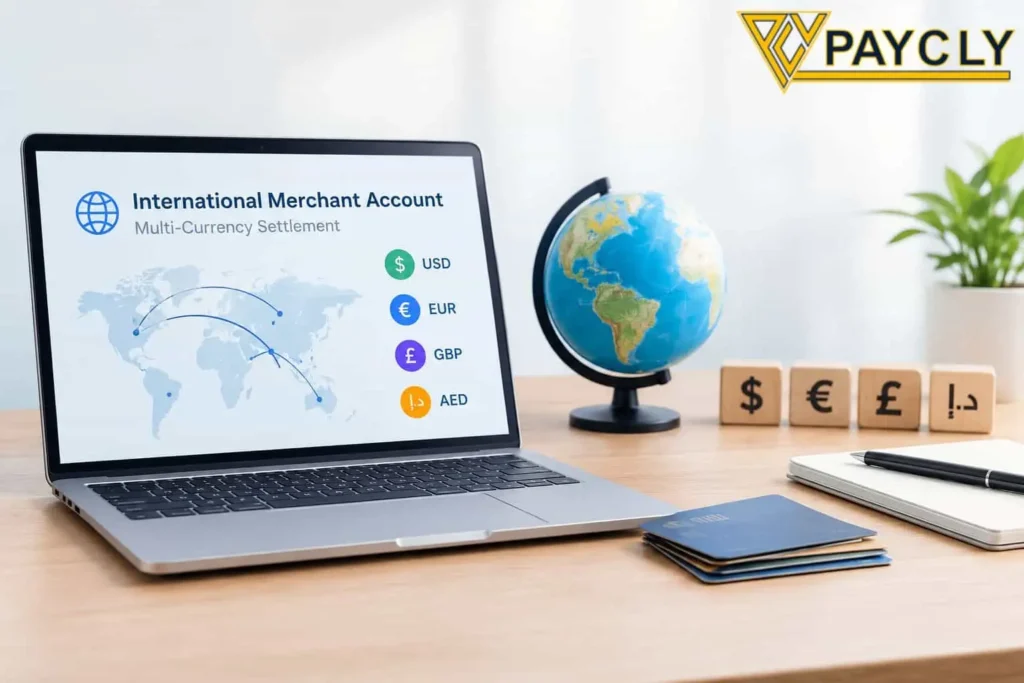
What Is an International Merchant Account with Multi-Currency Settlement?
An international merchant account with multi-currency settlement is a payment-processing arrangement that enables eligible businesses to accept payments from customers in different countries and, where supported, receive settlement in multiple currencies.
For example, an international e-commerce company may accept payments from customers in the United States, the United Kingdom, Germany, and the UAE. Depending on its provider and acquiring arrangement, it may accept payments in USD, GBP, EUR, and AED and settle eligible transactions in selected currencies.
It is important to understand the difference between multi-currency payment acceptance and multi-currency settlement.
- Multi-currency payment acceptance: Customers can pay in different supported currencies.
- Multi-currency settlement: The merchant can receive funds in specified currencies, subject to provider capabilities, eligibility, and banking arrangements.
- Currency conversion: Payments are converted from one currency to another when required, potentially involving foreign-exchange fees or markups.
A payment gateway may support international transactions without offering settlement in every currency accepted at checkout. Businesses should confirm both capabilities before choosing an international payment processing solution.
Why Global Businesses Need Multi-Currency Merchant Accounts
Expanding into international markets introduces new payment requirements. Customers may prefer familiar currencies, while merchants need an efficient way to manage revenue, expenses, refunds, and reconciliation across different regions.
A suitable global merchant account can help businesses address these operational requirements.
1. Better Checkout Experience for International Customers
Customers may feel more comfortable purchasing when prices are displayed in their preferred currency. Offering supported local-currency payment options can make pricing easier to understand and reduce uncertainty during checkout.
For example, a digital services company could display prices in USD for American customers, GBP for UK customers, EUR for eligible European markets, and AED for customers in the UAE.
2. More Flexible International Settlement
Businesses with international suppliers, employees, or operating expenses may benefit from receiving funds in currencies that match their financial obligations.
Depending on the provider’s arrangements, settling in an appropriate currency may reduce unnecessary conversion steps. However, actual savings depend on exchange rates, settlement fees, bank charges, and the merchant’s currency requirements.
3. Improved Financial Visibility
Managing international transactions through a suitable payment platform can simplify reporting, transaction tracking, and reconciliation.
Businesses should look for multi-currency payment processing features that provide clear transaction records, settlement reports, refund information, and currency-level reporting.
4. Support for Cross-Border Expansion
A scalable international merchant account for global businesses can help companies serve new markets without unnecessarily complicating their payment infrastructure. Availability remains subject to supported countries, payment methods, business categories, and underwriting approval.
Why High-Risk Merchants Struggle with International Payment Processing
High-risk merchants often experience payment challenges that extend beyond currency conversion. Their business models, transaction patterns, regulatory exposure, and potential dispute levels may require more detailed underwriting.
Merchant Account Rejections and Limited Provider Options
Forex businesses, gaming operators, subscription platforms, and other higher-risk merchants may struggle to find providers willing to support their specific activities.
An application may be declined because of unsupported industries, incomplete documentation, licensing concerns, high dispute levels, or exposure to restricted markets.
Repeated applications without addressing these issues can delay expansion and waste valuable time. Merchants should choose providers that assess their actual business model and confirm whether the proposed activity is supported.
Rolling Reserves and Restricted Working Capital
A rolling reserve allows an acquiring provider to withhold an agreed percentage of processing proceeds for a specified period to cover potential disputes, refunds, and other liabilities.
Consider a merchant processing $150,000 monthly. If the agreement requires a 10% rolling reserve, $15,000 of that month’s processing volume would be allocated to the reserve, subject to the contract’s calculation and release terms.
This can place pressure on cash flow, particularly when a merchant must pay advertising costs, employees, suppliers, and international operating expenses.
Before signing a high-risk merchant account agreement, businesses should review reserve percentages, holding periods, release schedules, and the conditions under which reserves may change.
High Processing Fees and Hidden Charges
International payment processing may involve interchange, card-scheme fees, acquiring margins, cross-border charges, currency conversion, and other service fees.
High-risk merchants may face less favourable pricing than lower-risk businesses. Additional charges for refunds, chargebacks, gateway access, or account maintenance can further increase costs.
The solution is to compare the total cost of acceptance rather than choosing a provider solely because it advertises a low transaction rate.
Chargebacks, Fraud, and Account Stability
Card-not-present businesses must manage unauthorized payments, customer disputes, friendly fraud, and recurring-payment complaints.
For subscription businesses, unclear billing terms can lead to disputes. Forex and gaming merchants may encounter disputes related to account funding, withdrawals, service expectations, or customer dissatisfaction.
Rising chargeback levels can lead to additional scrutiny, higher costs, processing restrictions, or account termination, depending on the circumstances and applicable rules.
Merchants should evaluate fraud screening, transaction monitoring, appropriate authentication, clear refund policies, and effective dispute-management processes alongside their payment-processing solution.
Unpredictable Settlement Timelines
High-risk merchants may face settlement delays, reserve requirements, or additional account reviews. These restrictions can make it difficult to forecast available funds and manage cross-border obligations.
A suitable payment partner should explain settlement schedules, reserve conditions, transaction reviews, and the documentation required when unusual activity occurs.
What to Look for in a Multi-Currency Merchant Account Provider
Choosing a provider requires a careful review of commercial terms, currency support, and industry eligibility.
| Evaluation factor | What to check |
| Currency acceptance | Support for USD, EUR, GBP, and AED where required |
| Settlement currencies | Which currencies are available for merchant payouts |
| Settlement schedule | Expected settlement frequency and applicable conditions |
| High-risk eligibility | Whether the provider supports the specific business activity |
| Processing costs | Transaction fees, cross-border charges, and currency-conversion markups |
| Reserve requirements | Reserve percentage, duration, and release conditions |
| Fraud prevention | Available screening, authentication, and monitoring tools |
| Reporting | Transaction records, refunds, settlement reports, and reconciliation |
| Integration | Compatibility with the merchant’s website, billing system, or API |
| Compliance | Applicable KYC, AML, licensing, and payment-security requirements |
Merchants should also ask how the provider handles transaction-volume increases, changes in average transaction values, unusual payment patterns, and requests for additional documentation.
Clear answers before onboarding can help businesses avoid unexpected operational restrictions later.
How PayCly Supports International Payment Requirements
Businesses exploring an international merchant account with multi-currency settlement need a payment partner that understands cross-border commerce and the practical requirements of international transactions.
PayCly presents multi-currency processing and international payment capabilities for businesses serving customers across global markets. Its published features include support for more than 100 international currencies, alongside payment solutions intended to help merchants manage international transactions. Availability of specific currencies and settlement arrangements should be confirmed directly with PayCly.
For businesses with higher-risk profiles, the initial assessment should cover several important factors:
- Business model: Explain the products or services offered and identify any relevant industry-specific requirements.
- Target markets: Specify where customers are located and which countries the business intends to serve.
- Currency requirements: Identify whether USD, EUR, GBP, and AED are needed for payment acceptance, settlement, or both.
- Processing profile: Provide expected monthly turnover, average transaction value, transaction frequency, and available processing history.
- Compliance documentation: Prepare company registration details, ownership information, relevant licences, website policies, and other requested records.
- Cash-flow requirements: Explain preferred settlement timelines and any operational need to hold funds in particular currencies.
These details help establish whether a proposed arrangement may fit the business’s requirements. Final eligibility, pricing, settlement terms, and currency availability depend on the relevant underwriting and acquiring arrangements.
Businesses experiencing repeated rejections, expensive processing, or restrictive settlement terms can use this assessment to identify their priorities before applying for another account.
How to Apply for an International Merchant Account
A well-prepared application can make the review process more efficient, although approval timelines and outcomes vary.
Step 1: Define your payment requirements: Identify your target countries, required currencies, expected monthly volume, average transaction value, and preferred settlement currencies.
Step 2: Prepare your documentation: Organize company registration records, ownership details, bank information, relevant licences, website terms, refund policies, and processing statements where available.
Step 3: Complete the underwriting assessment: Explain your business model, customer locations, transaction patterns, chargeback history, and existing payment arrangements.
Step 4: Compare commercial terms: Review processing fees, foreign-exchange markups, reserve conditions, settlement schedules, and termination clauses.
Step 5: Test the payment integration: Verify checkout functionality, transaction reporting, refunds, reconciliation, and fraud controls before increasing international transaction volumes.
Frequently Asked Questions
Q: Can one international merchant account accept USD, EUR, GBP, and AED?
Some merchant-account arrangements support multiple transaction currencies through one integrated payment setup. The exact currencies available for acceptance and settlement depend on the provider, acquiring arrangement, merchant location, and business category.
Q: What is the difference between multi-currency acceptance and multi-currency settlement?
Multi-currency acceptance allows customers to pay in different supported currencies. Multi-currency settlement allows eligible merchants to receive funds in specified currencies. A provider may offer one capability without offering the other for every currency.
Q: Can high-risk merchants obtain international merchant accounts?
Yes, some providers and acquiring arrangements support eligible high-risk businesses. Approval depends on the business activity, licensing, jurisdiction, transaction profile, compliance documentation, and risk assessment. No provider can guarantee approval for every applicant.
Q: Does multi-currency settlement eliminate foreign-exchange fees?
No. It may reduce unnecessary conversions in suitable circumstances, but foreign-exchange markups, banking charges, and other fees may still apply. Merchants should compare the complete pricing structure and confirm which currencies are available for settlement.
Q: How do rolling reserves affect international merchants?
Rolling reserves temporarily restrict access to part of a merchant’s processing proceeds. This can reduce working capital and affect the ability to pay operating expenses. Reserve terms should be reviewed carefully before an agreement is signed.
Q: What documents are required for an international merchant account?
Requirements vary by provider and industry. Common documents include company registration records, ownership details, identity verification, business bank information, relevant licences, website policies, and transaction-processing history where available.
Explore International Payment Solutions with PayCly
An international merchant account with multi-currency settlement can help businesses manage cross-border payments, serve customers in different markets, and plan their payment operations more effectively. However, successful international expansion depends on more than accepting multiple currencies.
High-risk merchants must also consider underwriting eligibility, processing costs, chargeback exposure, reserve requirements, and predictable access to settlement funds.
PayCly provides an opportunity for businesses to explore international payment-processing capabilities based on their operational requirements. Before selecting a solution, confirm supported currencies, settlement arrangements, total processing costs, and industry eligibility.
Looking for an international merchant account for your business? Contact PayCly to discuss your payment-processing requirements and explore options for supporting your international growth.