
In today’s rapidly evolving payments landscape, smarter risk intelligence is becoming essential for high-risk businesses that can no longer rely on outdated static rules or single-gateway setups. As highlighted in our pillar guide, “The Future of High-Risk Payments Processing: Trends & Technologies Shaping 2026”, the world of high-risk payment processing is shifting toward smarter, data-driven systems that not only protect revenue but also optimize customer experience.
High-risk merchants — from forex trading platforms and online gaming sites to adult content services and dating platforms — face constant challenges: higher chargeback ratios, regulatory scrutiny, and the need to approve legitimate transactions without delay. In 2026, the key to navigating this complex environment lies in smarter risk intelligence, powered by AI, behavioral analytics, and adaptive rules.
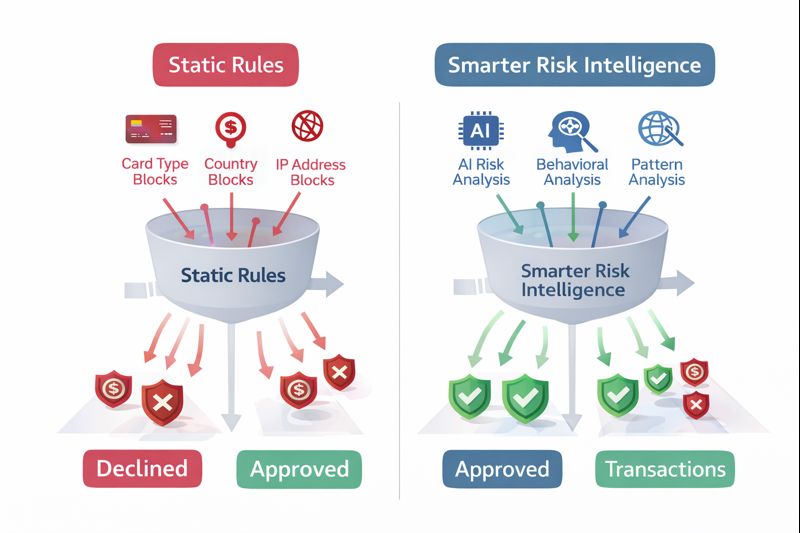
Why Traditional Risk Systems Are No Longer Enough
For years, high-risk payment gateways relied on static, rule-based systems. These systems would automatically block transactions from certain countries, IP ranges, or card types. While effective at reducing some forms of fraud, they often resulted in false declines, frustrating legitimate customers and damaging approval rates.
High-risk merchants operating under high risk merchant accounts quickly realized that rigid rules could cost more in lost revenue than the fraud they prevented. In 2026, success is no longer measured only by the number of blocked fraudulent transactions but also by how intelligently a system distinguishes between genuine and risky behavior.
How AI and Behavioral Analytics Transform Risk Decisions
Modern high-risk payment processing is powered by AI fraud detection that goes beyond basic heuristics. By analyzing transaction patterns, customer behavior, and historical data, AI systems can identify subtle signals of fraud while allowing legitimate transactions to pass.
For example:
- Behavioral Analysis: AI can detect unusual login patterns, inconsistent payment methods, or rapid transaction attempts, flagging them for review rather than outright rejection.
- Pattern Recognition: The system learns from global trends and industry-specific behaviors, refining its approval algorithms over time.
- Adaptive Rules: Instead of static country or card restrictions, rules adjust dynamically based on transaction risk, user history, and real-time intelligence.
For businesses using credit card payment solutions or managing a credit card merchant account, these advancements mean fewer declines, higher approval rates, and reduced operational friction.
Practical Steps for Implementing Smarter Risk Intelligence
High-risk merchants don’t need to overhaul their entire payment system overnight. Several practical strategies can help implement smarter risk intelligence effectively:
- Leverage an AI-Powered Gateway
Partner with an international payment gateway or high risk payment gateway that incorporates AI analytics. This allows you to detect fraud early while keeping approval rates high. - Segment Customers by Risk Profile
Use behavioral data to categorize users into different risk tiers. Transactions from low-risk customers can be auto-approved, while high-risk transactions receive additional verification. - Implement Multi-Layered Fraud Tools
Combine AI with traditional rules, velocity checks, and device fingerprinting to create a comprehensive defense. For businesses like gaming merchant accounts or forex merchant accounts, this layered approach balances security and revenue protection. - Monitor and Adjust Continuously
AI systems require training and feedback. Continuously monitor transaction outcomes, false declines, and chargeback rates. Adjust rules and models to reflect changes in user behavior, payment methods, and fraud tactics. - Educate Your Team
Risk intelligence is not just technology — it’s also people. Ensure operations and finance teams understand AI signals, risk scoring, and intervention protocols to respond quickly when alerts arise.
Benefits for High-Risk Merchants
Implementing smarter risk intelligence in 2026 offers clear advantages for high-risk payment processing:
- Fewer False Declines: Genuine customers can complete transactions seamlessly.
- Higher Approval Rates: More revenue flows through your platform without compromising security.
- Reduced Chargebacks: Dynamic monitoring and AI interventions prevent fraud before it impacts your bottom line.
- Enhanced Compliance: Intelligent systems help align with regional regulatory standards, making high risk business processing smoother.
- Scalable Operations: Whether you manage online dating merchant accounts, adult merchant accounts, or casino merchant accounts, AI-powered risk intelligence supports growth across regions.
Integrating Smarter Risk Intelligence With Your Payment Stack
To maximize effectiveness, risk intelligence should integrate with your existing payment infrastructure:
- Pair your credit card merchant account with AI-enabled fraud tools.
- Combine traditional high-risk payment gateway protections with alternative payment methods to diversify risk.
- Monitor multi-currency transactions for international operations, particularly for forex payment processing and global gaming platforms.
By creating a cohesive system, you reduce operational headaches while improving approval ratios and customer satisfaction.
The Bottom Line
As 2026 unfolds, the future of high-risk payment processing is clear: smarter, AI-driven risk intelligence is no longer optional — it’s essential. Businesses that adopt adaptive fraud detection, behavioral analytics, and layered rules will outperform competitors, reduce revenue loss, and build trust with customers worldwide.
At PayCly, we empower high-risk merchants to implement intelligent, compliant, and scalable payment solutions that work seamlessly with existing credit card and alternative payment setups. Whether you operate a forex merchant account, gaming merchant account, or online dating merchant account, integrating smarter risk intelligence can transform your approval rates and safeguard revenue.
Ready to reduce false declines and optimize approvals for your high-risk business? Connect with a PayCly payments expert today to explore AI-powered solutions tailored for your industry.
FAQS
1: What is smarter risk intelligence in high-risk payment processing?
Smarter risk intelligence refers to the use of advanced analytics, behavioral data, and AI-driven decisioning to evaluate transactions in real time. Instead of relying on rigid, rule-based filters that block entire regions or card types, modern risk intelligence analyzes how users behave, how transactions flow, and how patterns evolve over time.
For high-risk payment processing, this approach allows merchants to identify genuine customer intent while still detecting fraud early. The result is a more balanced system that protects revenue without unnecessarily rejecting legitimate transactions.
2:How does AI reduce false declines for high-risk merchants?
AI reduces false declines by understanding context rather than reacting to isolated signals. Traditional systems might block a transaction based on location, device, or transaction size alone. AI, on the other hand, evaluates multiple factors together — including user behavior, transaction velocity, historical activity, and global risk trends.
By learning from past approvals and declines, AI continuously refines its risk models. This allows high-risk merchants to approve more legitimate transactions while still stopping fraud, leading to higher approval rates, better customer experience, and fewer lost sales.
3: Is AI risk intelligence necessary for high-risk merchant accounts in 2026?
Yes, AI risk intelligence has become essential for high-risk merchant accounts in 2026. Payment fraud tactics are more sophisticated, and customer behavior across global markets is far more complex than traditional systems can handle. Static rules alone are no longer effective in managing risk at scale.
AI-driven risk intelligence helps high-risk merchants adapt to changing fraud patterns, comply with evolving regulations, and process payments efficiently across regions. For businesses aiming to grow sustainably while maintaining approval rates and compliance, AI-based risk systems are no longer optional — they are a core requirement.